
Summary:
The character of Okonkwo in Chinua Achebe's "Things Fall About" is obsessed with proving his masculinity, often by beating his wife and son. This chracter flaw leads to misery for him and his family.
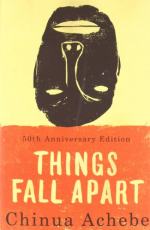
The novel Things Fall Apart by Chinua Achebe is a story that opens the reader's mind to an entirely different way of living in a Nigerian village. Achebe was born in Nigeria in 1930, perhaps this is why he writes a whole book on a Nigerian village and introduces to us the ways of life for the Nigerian people. From the first page of the book to the last, Achebe allows the reader to enter the mind of the main character Okonkwo. Okonkwo is the leader of his village and is very respected for his many achievements. Although Okonkwo means well for his village, the novel invites the reader to see him has a flawed character who eventually suffers from the consequences of bad "masculine" decisions he makes throughout the book.
Okonkwo is known throughout Umuofia to be extremely masculine. He rarely shows signs of fear or weakness. This is because Oknokwo promised himself he would be the complete opposite of his father Unoka. Unoka had passed away ten years prior to when the story takes place but he has always been remembered as a weak, lazy, poor man who could barely provide for his family. He was always in debt and didn't care to work, he would play his flute all day everyday if he was able to. "People laughed at him because he was a loafer, and they swore never to lend him any more money because he never paid back" (5). Unoka was the laugh of the town and Okonkwo would never allow himself be that.
Throughout the novel, Oknonkwo does many things to prove his masculine quality. Many of these things are debatable as to whether they affirm Okonkwo's masculinity or if they bring out his true weakness and lead to his destruction. (Goldman 2)
One thing that Okonkwo repeatedly does throughout the novel is beat his wives. Within the Nigerian culture, some say that this is what a real man does, but others argue that Okonkwo beats them because he is truly weak at heart. Okonkwo never really has a 'legitimate' reason as to why he beats his wives. It begins early in the book, in chapter four, when we experience the outcome of Okonkwo's "manly" side. Okonkwo is furious with his youngest wife Ojiugo when his afternoon meal is not prepared for him. He is even more angered when he finds out she went to braid her hair at her friend's house. Okonkwo waits in his obi, the living quarters of the head of the family in the village, for the return of his wife. When Ojiugo finally comes home, she is greeted with a harsh beating by Okonkwo. It just so happens that this incident occurred during the Week of Peace but this surely did not stop Okonkwo from beating his wife. Oknonkwo ended up suffering for what he did. Ezeani, the priest of the earth goddess Ani, met with Okonkwo to discuss his actions. He said to him "the evil you have done can ruin the whole clan...you will bring to the shrine of Ani tomorrow one she-goat, one hen, a length of cloth and a hundred cowries" (30-31). One would think this consequence would change Oknonkwo's mind about beating his wives, but that of course is not the case.
Okonkwo's second wife is was rewarded with a beating by Okonkwo when she cuts leaves off of a banana tree. Okonkwo over exaggerated about the condition of a banana tree and took his anger out on his second wife. He gave her a beating and walked away satisfied. His next plan was to go hunting and when he asked Ikemefuna to fetch his gun, the wife who had just been beaten mumbled something and unfortunately for her, Okonkwo heard her. He proceeded into his room where he got his loaded gun and aimed it at his wife. There was a loud noise that (Goldman 3) left his wife luckily unhurt, but very frightened. "He heaved a heaved a heavy sigh and went away with the gun" (39). Okonkwo feeling no shame for what he did definitely foreshadowed his heartless 'manly' actions that would lead him down the pathway to misery further into the book. Anyone who can not accept the actions of others and shows it so violently, is obviously going to end up miserable by themselves.
Not only does Okonkwo beat his wives, he beats his son Nwoye as well. Because he fears weakness, Okonkwo is very demanding of his family. He seems to think his son is more like a woman than a man and finds him to be very lazy. Nwoye resembles his grandfather and that is something Okonkwo cannot deal with. On numerous occasions Okonkwo would hit his son and if Nwoye was lucky, he would just be threatened. One day, Nwoye was cutting up yams and Okonkwo was upset with the size of the pieces. He said to his son "if you split another yam of this size, I shall break your jaw" (32). This "masculine" behavior of Okonkwo truly begins to reveal a tragic character flaw.
Further into the book Okonkwo's masculine behavior really becomes outrageous when he takes the life of a young boy, who is like his surrogate son. Ikemefuna is a boy from a neighboring clan who was sent to live with Okonkwo for three years because his father had killed a daughter of Umuofia. During those three years a strong relationship was built between the two of them, but of coarse Okonkwo showed no affection. Okonkwo would consider himself weak and a failure if he did so, so his only emotion would be anger. "His whole life was dominated by fear, the fear of failure and weakness" (13). This fear prevented Okonkwo from opening up to others, especially his family, and accepting reality. He believed his 'manly' ideas of what should be done in the village was what all the villager's should think. Surprisingly though there were (Goldman 4)times that Okonkwo allowed Ikemefuna to accompany him to feasts, like a son, and Ikemefuna did call Okonkwo father. In chapter seven, Okonkwo learns that Umuofia has decided to kill Ikemefuna. Ogbuefi Ezeudu, the oldest man in the quarter of Umuofia, is the one who breaks the news to Okonkwo. He also tells Okonkwo that since Ikemefuna calls him father he must not take any part in his murder. Obviously, Okonkwo would not listen to Ezeudu's orders. Okonkwo went along with a group of elders through the forest where they were leading Ikemefuna to his death. When the time was right, one of the elders drew his machete and Okonkwo looked away. Ikemefuna fell to the ground and yelled "my father, they have killed me!" (61). Once again, being afraid of being thought as a weak man, Okonkwo draws his own machete and cuts the boy down, ending his life.
The final incident that makes Okonkwo suffer most occurs during Ezeudu's funeral. Ezeudu was very much respected in the village and so all of the clan attended his funeral. The service was unlike all others because the "one-handed spirit" made an appearance. He made his way over to Ezeudu's body and spoke: "if your death was the death of nature, go in peace. But if a man caused it, do not allow him a moment's rest" (123). All of a sudden the most bizarre thing happened. There were cries and shouts of horror. It was as if the one-handed spirit had cast a spell on Okonkwo before he left. In the center of the cluster of people laid the dead body of Ezeudu's sixteen year old son. It just so happens that Okonkwo's gun had exploded and a piece of iron had went through the boys heart. Everyone was confused. Deaths were common in the village but nothing of this nature had ever happened. This incident was definitely meant to happen so Okonkwo's life would be ruined. It was as if he was being punished for all the harsh things he had done to people in the past, like his wives and son. It is from here on out that we see (Goldman 5) the life of Okonkwo go downhill.
Okonkwo would come face to face with his fear. His dream of becoming one of the lords of the clan was shattered. He had have to flee from the clan for seven years. How could a strong, brave warrior like Okonkwo be humiliated with such a consequence? He had no choice though. That night he gathered his belongings and him and his family set out to seek refuge in his motherland. During Okonkwo's absence from Umuofia, many things went on that Okonkwo would never have thought would happen.
White men came to Umuofia. After two years of Okonkwo being in exile, Obierka had went to visit Okonkwo and told him stories about what was going on back in the village. He told him that a group of white man had destroyed a village called Abame and almost everybody in it. Two years after this, Obierka returned with even worse news. White missionaries had now settled in Umufoia. They built a church there and had many villagers following them. Worse than that, Obierka told Okonkwo that Nwoye was indeed one of the converts. Okonkwo wished to not speak about it. Okonkwo had to have known this was going to happen. He treated Nwoye with no respect and looked down upon him. He showed him no affection what-so-ever .
Okonkwo could not do anything about the white men. He was miles away from Umufoia and still had a few years left before he could return. For once, he was unable to make "masculine moves" and take charge. If only he knew to the extent what was really going on in his village. The white men were spreading Christianity all over. They were getting the villagers to break their traditions, escape their culture, and believe their gods were dead. They even demanded that the villagers attend church every seventh day to worship their god. They were destroying the Evil Forest and building houses for themselves. Surprisingly, no one was stopping them. It was (Goldman 6)as if the villagers did not care that their lives were being taken over and would soon be changed forever. By the time Okonkwo would return, everything would be different.
When it was time, Okonkwo and his family returned to their homeland. He had regretted not being able to be in Umufoia the past seven years. He knew he lost everything. He lost the chance to lead his clan against the white man's religion and lost the chance to win the highest title in the clan. "But some of these losses were not irreparable. He was determined that his return should be marked by his people. He would return with a flourish, and regain the seven years wasted" (172). Had Okonkwo not thought this, the reader would be shocked. It is obvious that Okonkwo would want to take charge in his village again. After all, if he was not determined, could we not consider him weak and a failure"
He gathered his clansmen in the marketplace and to his surprise they listened with respect. Although they did not agree to kill the missionary or turn against the Christians like Okonkwo wanted, they agreed they would do something. For the next few days, the men in Umuofia went about their business armed with weapons. They promised Okonkwo they would not be naive and unaware like the men in Abame. Then one day the District Commissioner returned to Umuofia from his tour. He sent his messenger to the leaders of Umuofia to tell them to meet him in this headquarters to chat. Obviously, Okonkwo was among one of the six leaders.
Okonkwo demanded that the other leaders be armed and ready for anything. He told them "an Umuofia man does not refuse a call. He may refuse to do what he is asked, he does not refuse to be asked" (193). It is clear here that the only thoughts running through his head were masculine thoughts. He needed to show the men that he was not afraid and he would be willing to go to war even if they were not. They six off them did as what they were asked and went to the Goldman 7 courthouse where the District Commissioner was waiting. He told them the reason he had gathered them was because he wanted to discuss things that happened while he was gone. Without further a due, he surprised the six leaders with appearances from his own men and before anyone can do anything, Okonkwo and his friends were handcuffed and led into the guardroom. Although the court messengers were told to treat the six of them with respect, they did not. For the next few days the men were deprived of food and water. Okonkwo consistently told the men "we should have killed the white man ..." (195) and finally they got fed up with what was going on that they agreed with him. It is unfortunate though that Okonkwo only wanted to kill the white man because he was afraid they would succeed in changing the traditions of Umuofia. Maybe if Okonkwo was willing to accept change, the six of them would not have been locked up like criminals. Days after, the messengers were going into town and telling the people of Umuofia that their leaders would not be released until they paid a fine of 250 bags of cowries.
The news spread quickly throughout the village. One night the village crier beat his instrument and called every man of Umuofia to a meeting in the marketplace. After the meeting, the men of Umuofia decided to collect the 250 bags of cowries to give to the white men. The men were pleased and set the six men free. The next day there was another meeting, this time with the six leaders. Okonkwo didn't sleep that night. All he thought about was revenge. He couldn't believe how him and his men were treated by the white men. If Umuofia decided to go to war, he would be very happy. But if not, he would take things into his own hands and go to war alone, like any 'real man' would do.
Morning came and the marketplace was filled with the non-converts. The first person to speak was Okika, one of the leaders locked up by the white men. He told the listeners that they Goldman 8 must go to war even though some of the strangers they would be fighting might perhaps be their own kind. He says "we must root out this evil. And if our brothers take the side of evil we must root them out too" (204). It is unfortunate that the villagers were turning on one another. At this point, everyone became silent. Out of no where appeared five court messengers. Okonkwo was very close to them. He immediately stood up when he saw them and greeted the head messenger with feelings of strong hatred. The messenger told Okonkwo that the white men wanted the meeting to stop. Within seconds, Okonkwo drew his machete, cut the messenger's head off, and walked away. That was the last time anyone would see Okonkwo. He took his own life and hung his lifeless body to a tree.
How can one be sympathetic to the plight of Okonkwo? His obsession with his masculine side made him suffer. He did it to himself. If he wasn't so caught up on the idea that if you weren't violent and brave then you were a woman, perhaps he would still be alive at the end of the novel. He takes his own life because he realizes everything he has done to be that powerful leader he has always wanted to be was a waste. When he comes back from exile, everything is different. He realizes that the people in the village don't need him. They are content with change and adapting to a new way of life, unlike himself. They don't want to go to war and have bloody battles like he does. Okonkwo realized his village was able to survive without him. By Okonkwo taking his own life, he proved his misery and the idea of him being truly weak at heart was affirmed.
This is the complete article, containing 2,720 words
(approx. 9 pages at 300 words per page).

