
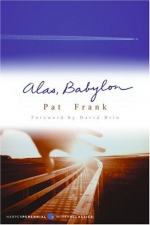
Summary:
Pat Frank's novel "Alas, Babylon" is an example of "speculative fiction," a story that imagines the future. The novel poses interesting scenarios about what would happen if much of the world was destroyed in an apocalyptic war.
Throughout the book of Alas Babylon, there are many independent themes that are addressed to illustrate Pat Frank's ideas. Shown in this book are the ideas of what would come to be if the world were thrown into a nuclear war. Such themes as disintegration of the American way, as well as rebuilding the ways of humanity are present throughout this book, which is classified as speculative fiction.
Speculative fiction usually imagines a future progressing forward. Alas, Babylon, however, deals with a future jerked the other way, where people living in the present are thrown back into almost primitive times forced to barter or grow their own food, and deal with crime(EmptyWorld). Alas, Babylon's picture of post-apocalypse life is strangely compelling with its use of very life like characters as well as vivid imagery. The idea of a serious part of the world being blown away provides for a unique storyline and provides for an engrossing plot. This 40-year-old story about the long-dead Cold War still proves to be fresh and provocative and makes you think "what if, "(CNN Interactive). The story's intensity and honesty make it possible to imagine what it would be like to live in a world after bombs have destroyed the cities and unraveled the fabric of every day life(293). It becomes evident that the boys of Fort Repose are forced to quickly become men, and the common man must work harder than ever to survive, yet they remain the luckiest of a majority of the American population.
One classic theme that is illustrated throughout this story is that of the strong-will of man. Once an unmotivated bum whose relative wealth allowed him to toy at the idea of a political life, Randy becomes more vital and alive and a motivator to everyone. Through his actions as well as his general persona, Randy can easily be compared to someone like a sheriff on the American frontier. He bases his actions on personal goodwill and does what he has to do to keep order in the town as well as feed his family. Even if there had been only this left of America, Fort Repose would not have been a problem with Randy as their leader.
Written in 1959, Alas, Babylon can be seen as a very influential book of this cold war era. The Vietnam and Korean War fell in the time period of "Cold War",though, by definition, the Cold War was not a war of bullets at all(CNN Interactive). Fought in politics and society, it was merely a period of increased animosity between Western countries, primarily America, and all communist countries(CNN Interactive). Coincidently, a part in this book explains the findings of four skunks, or unidentified submarines in the Gulf of Mexico and the Caribbean. This is strangely similar in the presence of submarines threatening to shoot, the likeliness of nuclear war between The USSR and the United States, and the Cuban Missile crisis five years after the publishing in October of 1962(CNN Interactive).
In addition to Alas, Babylon, Pat Frank was also the author of Forbidden Area and Hold Back the Night. In Forbidden Area, Frank warned of the danger of an attack from the Russians in which America would not have time to react(Empty World ). Hold Back the Night is an account of the withdrawal from the Korean reservoirs during the very worst days of the Korean War(Empty World ). Frank wrote a great deal of material - fiction and non-fiction - dealing with the possible problems with atomic materials (HarperCollins). His first novel, Mr. Adam, hypothesizes about universal male sterility as one of the results of an explosion at an atomic bomb factory in Mississippi(Empty World).
A method of writing that Pat Frank uses to illustrate his point is that of using biblical allusions to add force and impact. The title of "Alas, Babylon" is pulled from The Bible foreshadowing an event to end a civilization: "Alas, alas, that great city of Babylon, that mighty city! for in one hour thy judgment come" (34). Using these allusions, Frank succeeds in reaching the root of his target audience appealing to their beliefs in Christianity and perhaps what would come about if nuclear proliferation were to continue. The final impact of such a story is difficult to be seen this soon afterwards, if even at all. Pat Frank does a fine job at pointing out the faults and weaknesses of both sides during this time period and what it could hypothetically lead to an Empty World.
This is the complete article, containing 751 words
(approx. 3 pages at 300 words per page).

