
Summary:
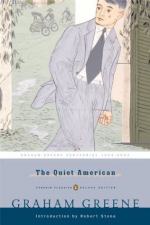
The character Alden Pyle in Graham Greene's novel The Quiet American is a very patriotic, idealistic American who believed he could make a difference in the world in a country that he knew very little about. Pyle's innocence, naïveté, and inability to see the big picture would lead to fatal consequences for himself and for others.
The text, The Quiet American, is a story about two foreigners in China during the Indo-Chinese war. Thomas Fowler, a middle aged British reporter, and the other, Alden Pyle, who worked for the American Aid Mission. The two characters meet and their characteristics develop throughout the text. Although it appears that they are different, they are similar in subtle ways. Fowler appears as a close minded person who does not believe in God and does not get involved in Politics or other affairs. Pyle is very patriotic to America and rather idealistic in all that he does. Pyle seems to be naive towards thinking that he will be able to save a whole country, especially one as big as China. Just as he believes he can save Phuong Hai, by marrying her and getting her out of Vietnam. As Pyle's mind was fixated on one side of the war, his innocence steered him to an early death. Due to his nativity, Pyle could not see the big picture and this led to fatal consequences.
Pyle was a very naive young man with both his involvement in the war and his relationship with the young mistress Phuong. He believed he could make a difference in the world in a country that he knew very little about, if any. Pyle knew that he could not change the country alone, so he joined General Thè's army which was also known as the third force. Pyle believed that what he was doing was for the greater good for the country and he was determined to succeed despite the unimportant casualties lost. Pyle was focused on one side and his innocence blinded him. This resulted in Pyle being unaware of all the damage that he had caused by helping the third force.
The bombing at Saigon, where dozens of casualties died, shows clearly Pyle's innocence. When Fowler confronted Pyle about the cancelling of the Parade, Pyle admitted that he did not know and it wasn't his fault. He created poor excuses, such as being away, and truly believed that he was not to be blamed. Here we see Pyle's innocence blinding him from reality and he truly believed that he was not at fault. "He'll always be innocent, you can't blame the innocent, they are always guiltless." Furthermore Pyle states that General Thè wouldn't have done this and that it was the communists. He believed that the third-force would have not deceived him in such a way. Due to Pyle's naivety he did not see that he was merely being used to support some fanatics which never believed in his cause.
"Innocence is a kind of insanity." Pyle's ambitions to improve a country which he knew nothing about led to serious consequences. His naivety in the involvement of the war cost several lives and his self. If he had only thought about what he was doing and who he was affecting, Pyle may have broken out of his 'innocent' behaviour and show some remorse for his actions. However, he was stubborn and believed that the bombing was not his fault and that he wasn't deceived by General The. His innocent approach on the war soon led to an early death.
This is the complete article, containing 532 words
(approx. 2 pages at 300 words per page).

