
Summary:
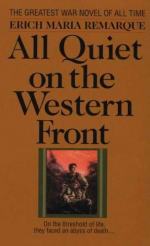
Discusses the novel "All Quiet on the Western Front." Describes how the men have lost all faith after fighting in the war.
From dusk until dawn, day after day, war had demolished men, cities, and hope. War had an effect on soldiers like nothing else, and had stuck with them for life. The way Baumer stated "Men will not understand us" (Remarque, 294), showed the reader his feelings and how no man or woman will have any idea on how much war affected life and how its reminiscences would be there, past, present, and future. Why is war so effective on the soldiers? Because they dealt with constant deaths, of friends, family, and the supposed enemy. Although some of the men at war had escaped the shells, they have been destroyed by war, not only physically, but emotionally as well.
The fate of a lost generation was made known when Baumer writes:
We are not youth any longer. We don't want to take the world by storm. We are fleeing. We fly from ourselves, from our life. We were eighteen and had begun to love life and the world; and we had to shoot it to pieces. The first bomb, the first explosion, burst in our hearts. We are cut off from activity, from striving, from progress. We believe in such things no longer. We believe in war.
After war, soldiers are left with traumatic memories. Those who have survived were left with the flashbacks of death, blood, cries, and the sounds of their comrades in agonizing pain, praying for death.
The men on the front were constantly faced with danger; they could get killed at any point in time. As this is such a physical risk, the soldiers' nerves were shot to pieces, leaving the men to not think and their reactions were derived from pure animal instinct. The soldiers' reactions were merely based on what they needed to do to survive, no matter what it was and no matter how inhumane the act may have been.
Animal instinct had been shown in the novel after Paul had stabbed one of the French soldiers, Gerard Duval. When the French man fell into the trench, Paul had focused on the first thing that had come to his mind- survival. Paul continuously stabbed the man over and over, until he realized, while as he watched the man lie there, motionless, that he too were human, and not an enemy.
War brought out the worst in the men, and in order for soldiers to survive, they had to disconnect themselves from the real world, from their feelings and emotions, to turn off their minds, and to react to situations on the spot. By having an unconscious mind, the men had committed hundreds of unnecessary deaths, one after another.
Besides the fact that men dealt with psychological pain and deaths of others, the soldiers were forced to live in horrible conditions; in filthy, sopping trenches full of rats and rotting corpses as well as infested with lice. They often went without food and sleep, ample clothing, or even satisfactory medical care. Along with their ways of living, the men were forced to deal with the frequent deaths of the soldiers close to them, more often then not; they died in a gruesome, and violent manner. After the men lost the one thing keeping them sane at war, they began to give up all hope of safety and survival. Those were only some of the conditions that affect the soldiers and leave them in panic and in pain.
After experiencing the battlefield, the soldiers were left with horrific thoughts and images of deaths. As so many men were wounded per day, they were sent to the hospitals for healing and treatments of their disgusting wounds and abrasions, and even when there were minor cuts and bleeding, the doctors insisted on amputation, this led the Germans to less soldiers day by day. According to Baumer, the hospitals alone show the horrors of war (263).
Besides the blood and gore, friendships were being lost; being another reason why war has such a huge effect on the soldier.
The way that soldiers had to disconnect themselves from their feelings and actions created a huge damaging impact on a soldiers' humanity. In the novel, Paul became unable to think of a future without the war and he was not able to remember his feelings from the past. Being at war, he had become a different person, and as he returned home, he lost the ability to even speak to his family, he felt like an outsider, and extremely unwelcome. Paul had even said it himself, he knew not what was a regular life, but what a life at war was. "I am young, I am twenty years old; yet I know nothing of life but despair, death, fear, and fatuous superficiality cast over an abyss of sorrow" (263).
In the very end of the novel, when Paul died, it was so quiet and calm on the whole front that it had been said that it was All quiet on the Western Front, this was very ironic because you can tell throughout the whole novel that all Paul was looking for was peace, and he found it in death. If Paul had lived on past the war, I think he would have lived a meaningless life because after all he saw, he did not want to live anymore and he had no hopes and dreams, this is what we call the fate of a lost generation.
Works Cited - the novel "All quiet on the western front"
This is the complete article, containing 911 words
(approx. 3 pages at 300 words per page).

