
BookRags.com Literature Guides Literature
Guides
Criticism & Essays Criticism &
Essays
Questions & Answers Questions &
Answers
Lesson Plans Lesson
Plans
My Bibliography Periodic Table U.S. Presidents Shakespeare Sonnet Shake-Up
Research Anything:        
History | Encyclopedias | Films | News | Create a Bibliography | More... Login | Register | Help


Student Essay on The Things They Carried: Coping With Death

Print-Friendly  Order the PDF version  Order the RTF version
Tim O'Brien
About 3 pages (906 words)
The Things They Carried Summary

Bookmark and Share Questions on this topic? Just ask!

The Things They Carried: Coping With Death

Summary:   Discusses the Tim O'Brien book, The Things They Carried. Examines how O'Brien conveys his approach to death, coping skills, and the loss of his childhood friend, Linda. Reveals how O'Brien used his coping skills in the Vietnam War.


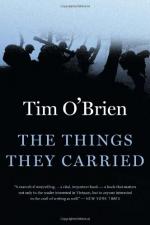
Death is one of life's most challenging obstacles. Tim O'Brien was exposed to more than his fair share of death. To manage the emotional stress, he developed methods of coping with the death in his life. O'Brien's novel, The Things They Carried, demonstrates his attempts to make death less real through psychotherapeutic tactics like telling stories about the dead as if they were living and conceiving the dead as items instead of people.

O'Brien explains how the stories told about those who have passed are meant to keep the deceased's life alive. The "weight of memory" was one thing all the solders carried (14). When added to the physical weight of their gear and the emotional burdens of war, it was all too much. In response, the men altered their perceptions of the truth in order to lighten the haunting weight of memory. O'Brien suggests "in a true war story nothing is ever absolutely true," memory is altered to compensate for its weight (82). In this way, O'Brien, and the rest of the men, were able to utilize "story-truth (179)." Stories alter truth; therefore, a well-told story can actually allow the dead to continue to live on. "In a story, the dead sometimes smile and sit up and return to the world (225)." In this way you could "keep the dead alive" with "blatant lies, bringing the body and soul back together (239)." O'Brien remembers listening to a story about Curt Lemon. He recalls how "you'd never know that Curt Lemon was dead (240)." It seemed like "he was still out there in the dark" yet, "he was dead (240)." Similarly O'Brien uses story to save his childhood friend's life, "not her body - her life (236)." In his stories Linda "can smile and sit up. She can reach out (236)." He allows her to come to life and "touch [his] wrist and [say], "Timmy, stop crying." (238)." O'Brien and the rest of the men are able to find a comfort in the unreal that the real cannot offer.

The solders in Vietnam were able to eliminate the reality of death through predictable responses (20). One response was to "call [death] by other names (21)." "If it isn't human, it doesn't matter much if it's dead . . . a VC nurse, fired by napalm, was a crisp critter. A Vietnamese baby, which lay nearby, was a roasted peanut (238-239)." This detachment made death easier to handle. Furthering the illusion that the dead were not really people, the men would interact with the corpses on a very dehumanizing level. For example, there was a corpse of an old man in a small town. "Dave Jensen went over and shook the old man's hand" and said "How-dee-doo (226)." " One by one the others did too (226)." They all shook the corpse's hand, except O'Brien. O'Brien did not touch the body because for him death was still real. He admits it was "Way too real (226)." He had not yet acquired the survival technique of distancing one's self from the reality of death.

The actuality of war in Vietnam required that the solders have coping techniques in order to retain any mental stability. War was death. "There were a million ways to die. Booby traps and land mines and gangrene and shock and polio from a VC virus (197)." The solders "carried the emotional baggage of men who might die" at any moment (21). "Ted Lavender was shot in the head on his way back from peeing (12)." "The dead were everywhere . . . some in piles" that "proximity to death" changes a person (242, 81). The men needed to develop these coping skills of distancing and selective memory in order to remain sane. "When a man died, there had to be blame" and it was always everyone's fault; yet, no one could handle the soul responsibility (176-177). Often times you held someone's life in your own two hands and were forced to live with the blame if you let go (150). If you were unable to delude yourself as to the reality of death and your part in it, terrible emotional stress was the result. "Lieutenant Cross found himself trembling . . . He felt shame. He hated himself . . . he burned the two photographs" that distracted him, seemingly causing the mistake that killed his solder, he "couldn't burn the blame (16-23)." The guilt and responsibility would destroy the solders if they did not practice coping techniques.

"War is hell . . . war is mystery terror and adventure and courage and discovery and despair and . . . war is nasty (80)." When it all happened it was not like "a movie you aren't a hero and all you can do is whimper and wait (211)." O'Brien and the rest of the solders were just ordinary people thrust into extraordinary situations. They needed to tell blatant lies" to "bring the body and soul back together (239)." They needed to eliminate the reality of death. As ordinary people they were not capable of dealing with the engulfing realities of death and war therefore they needed to create coping skills. O'Brien approaches the loss of his childhood friend, Linda, in the same way he approaches the loss of his comrades in the war as this is the only way he knows how to deal with death. A skill he learned, and needed, in the Vietnam War.

This is the complete article, containing 906 words (approx. 3 pages at 300 words per page).

More Information
  • View The Things They Carried: Coping With Death Study Pack
  • Search Results for "The Things They Carried: Coping With Death"
  • Add This to Your Bibliography
  • More Products on This Subject
    The Things They Carried: Azar's Characteristics
    The Things They Carried is a novel about the Vietnam War and how it affected the people involved. T... more

    Character Comparison in Tim O'Brien's "The Things They Carried"
    The central theme of the story is the age-old conflict of life and death. On a more personal l... more


    Ask any question on The Things They Carried and get it answered FAST!
    Answer questions in BookRags Q&A and earn points toward
    discounted or even FREE Study Guides and other BookRags products!
    Learn more about BookRags Q&A
    Copyrights
    The Things They Carried: Coping With Death from BookRags Student Essays. ©2000-2006 by BookRags, Inc. All rights reserved.

    Join BookRagslearn moreJoin BookRags


    About BookRags | Customer Service | Report an Error | Terms of Use | Privacy Policy

