
BookRags.com Literature Guides Literature
Guides
Criticism & Essays Criticism &
Essays
Questions & Answers Questions &
Answers
Lesson Plans Lesson
Plans
My Bibliography Periodic Table U.S. Presidents Shakespeare Sonnet Shake-Up
Research Anything:        
History | Encyclopedias | Films | News | Create a Bibliography | More... Login | Register | Help


Student Essay on A Review of 2001: a Space Odyssey

Print-Friendly  Order the PDF version  Order the RTF version
Stanley Kubrick
About 2 pages (693 words)
2001: A Space Odyssey (film) Summary

Bookmark and Share Questions on this topic? Just ask!

A Review of 2001: a Space Odyssey

Summary:   A review of the film 2001: A Space Odyssey, a Stanley Kubrick film. Compares the film with the Arthur C. Clarke short story upon which it is based.


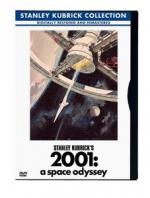
2001: A Space Odyssey is just that: a long wandering voyage of the body and mind. Stanley Kubrick and Arthur C. Clark collaborated brilliantly. In examining both works, the film and the novel, there are certainly differences, yet the theme and overall idea coincide thoroughly. That this was made in the 1960's augments both accomplishments. The visuals, seen in 2004, are still captivating. What they must've seemed like in 1968! I flout those who received this movie poorly in those days. Would I have received it as well without having a preconceived idea of its greatness? I can only hope I would have known what I was watching.

It is rare a movie inspires me to read the novel it is based on. Here is one occasion. On my first viewing of the film, I was baffled by the special effects so my appreciation was attained. This was done when digital effects did not exist. Scenes of the space station, the moon, Jupiter, Earth from space, and the sun are model works at their finest. However, I thought I did not fully grasp the story. After reading the book and seeing the film again, I realized I comprehended more than I gave myself credit for on that first watch. This is a work that was meant to raise questions rather than give solutions. At any rate, I was extremely pleased with the book, which brought about a need to see the film again.

My second viewing heightened my reverence for Stanley Kubrick. What he chose to include, change and eliminate is crucial to the film's success, as well as a tribute to his discretion. Clarke's novel does disentangle some details. There is no better way to completely realize the ascent to the Star Child than to read Clarke's final chapters. Still, cinematically, with no dialog or voice-over, Kubrick gives enough clues for an intelligent viewer to take in the concept. To a lesser extent, the trek Dave Bowman takes to another dimension/galaxy, which is explained in great detail in the book, cannot be fully construed visually. Still, you know what's happening when Bowman enters the "wormhole." Your eyes are lucky, too. If you ever wanted to experience true psychedelia and haven't the stomach for hallucinogens, here's your chance.

2001 originated from Clarke's short story, "The Sentinel." This, in no way, takes away from the originality of the film. An obvious benediction of the movie is Kubrick's use of music. The classical pieces intensify the sense of awe. From the ape man to the star child, the music detaches us from the events. We view them as we would events in a documentary. Kubrick deliberately adds, deletes and modifies. Hal never reads the lips of the astronauts in the book. This is a stroke of genius in the motion picture.

We are not as far along in space exploration as 2001 predicts we would be by now. It's eerily accurate nevertheless. With the Hal 9000 computer, we see humans as secondary in astronomical research. In today's actual space missions, humans are rarely even along for the ride. While technology is not capable of the malevolence seen in Hal, it is certainly as, if not more, important to the furthering of our knowledge, as Clarke envisioned in his writings.

The movie, coupled with the novel, awakened my interest in astronomy and particularly astrophysics. It also made me aware of the importance modern media and people in general place on somewhat trivial events, while our planet rotates on its own axis at one thousand miles an hour, and revolves around our sun at around sixty-six thousand miles an hour. These types of facts may seem trivial, but does the latest reality T.V. show, or the fact that Arnold Schwarzenegger called some other politician a girly man blow your mind"

Arthur C. Clarke was a forward thinker. His ideas on astronomy were far ahead of his time. Stanley Kubrick was extremely gifted at finding challenging pieces of literature and turning them into spectacular films. The film and the novel are transcendent. They evoke emotions beyond the everyday. Of course, if works of art like this were in abundance, they wouldn't be masterpieces.

This is the complete article, containing 693 words (approx. 2 pages at 300 words per page).

More Information
  • View A Review of 2001: a Space Odyssey Study Pack
  • Search Results for "A Review of 2001: a Space Odyssey"
  • Add This to Your Bibliography
  • More Products on This Subject
    Space Odyssey 2001
    Space Odyssey 2001 fits the definition of an epic. An epic can be defined as "a long narrative in el... more


    Ask any question on 2001: A Space Odyssey (film) and get it answered FAST!
    Answer questions in BookRags Q&A and earn points toward
    discounted or even FREE Study Guides and other BookRags products!
    Learn more about BookRags Q&A
    Copyrights
    A Review of 2001: a Space Odyssey from BookRags Student Essays. ©2000-2006 by BookRags, Inc. All rights reserved.


    Join BookRagslearn moreJoin BookRags


    About BookRags | Customer Service | Report an Error | Terms of Use | Privacy Policy

