BookRags.com Literature Guides Literature
Guides
Criticism & Essays Criticism &
Essays
Questions & Answers Questions &
Answers
Lesson Plans Lesson
Plans
My Bibliography Periodic Table U.S. Presidents Shakespeare Sonnet Shake-Up
Research Anything:        
History | Encyclopedias | Films | News | Create a Bibliography | More... Login | Register | Help


Student Essay on Analysis of Narrative Perspective in "the Lottery"

Print-Friendly  Order the PDF version  Order the RTF version
Shirley Jackson
About 2 pages (588 words)
The Lottery Summary

Bookmark and Share Questions on this topic? Just ask!

Analysis of Narrative Perspective in "the Lottery"

Summary:   Analyzes the effects of the narrative perspective used in Shirley Jackson's "The Lottery." Provides a character summary. Examines the irony between the story plot and setting.


"The Lottery" utilizes an objective third-person perspective to create suspense and foreshadow the ending. It begins by introducing a village and its people on a "clear and sunny" morning, "with the fresh warmth of a full-summer day" (NA, 781), with people finishing their tasks in order to gather for an annual town lottery. The narrator describes the community in a manner similar to that of an observant visitor. When the children leave school for the summer, with the boys gathering stones and the girls talking aside them, the reader is comforted by the light-hearted atmosphere of the village. It seems like a normal, idyllic town with simple people that seem stereotypic of a small rural community, where the men are absorbed in talking about "planting and rain, tractors and taxes"(NA, 781) and the women gather to exchange "bits of gossip" (NA, 782). In the beginning, the reader discovers that as opposed to larger towns that also hold the lottery, this village could finish the event in late morning and "still be through in time to allow the villagers to get home for noon dinner" (NA, 781). Mr. Summer, who carries out the drawing and who is described as a "round-faced, jovial man" (NA, 782), adds to the sense of normality in the town and upcoming lottery.

The ability of the story to create suspense lies in the fact that the narrator never reveals what the characters are thinking. Therefore, the reader begins to wonder why the lottery box is black, and why the villagers seem to be afraid of it even when they seem excited about the occasion. The mention of chants and other forgotten rituals that had accompanied past lotteries further mystifies the event, but then Mrs. Hutchinson arrives late at the town hall with her lighthearted jokes, the scene again appears to be an ordinary lottery drawing. As the drawing begins, the villagers are suddenly "quiet, wetting their lips, not looking around" (NA, 784). The reader is left to interpret the somber atmosphere; humorless grins of the townspeople reveal little about the source of their nervousness, even though something seems amiss. The suspense quickly builds and the scene becomes ominous as Mrs. Hutchinson cheerful countenance suddenly gives way to anxiety when her husband draws the winning slip. The narrator's perspective reveals only enough to allow the tension to build until the reader finally comes to the shocking realization that the lottery is actually a ritualistic murder.

Nevertheless, the author uses the objective viewpoint throughout the story to foreshadow the ending through the characters' behavior. The gathering of stones by young boys appears innocent, but the men in the town convene "away from the pile" (NA, 781), similar to the way in which they avoid the black lottery box. The manner in which the stones are chosen and aggregated suggests that there may be a purpose behind the activity. While the children enjoy themselves in "boisterous play" (NA, 781), the men appear unusually reserved. During the drawing when Old Man Warner repeats the saying, "Lottery in June, corn be heavy soon" (NA, 785) and openly disapproves of towns who give up the tradition, there is a hint that the lottery may actually be a type of sacrificial event. Although the ending unexpectedly shocks the reader upon first reading, the particular use of narrator perspective is actually able to foreshadow enough that the story seems to conclude naturally with the stoning of Mrs. Hutchinson.

References:

Bausch, Richard and Cassill, R.V. The Norton Anthology of Short Fiction (sixth edition). 2000.

This is the complete article, containing 588 words (approx. 2 pages at 300 words per page).

More Information
  • View Analysis of Narrative Perspective in "the Lottery" Study Pack
  • Search Results for "Analysis of Narrative Perspective in "the Lottery""
  • Add This to Your Bibliography
  • More Products on This Subject
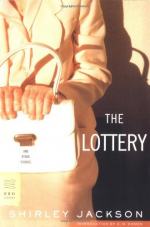
    The Lottery
    "The Lottery" In "The Lottery" Shirley Jackson presents us with a shocking story guaranteed t... more

    Sacrifices in "The Lottery"
    When most people reach the end of "The Lottery" they are abhorred and greatly disturbed. H... more


    Ask any question on The Lottery and get it answered FAST!
    Answer questions in BookRags Q&A and earn points toward
    discounted or even FREE Study Guides and other BookRags products!
    Learn more about BookRags Q&A
    Copyrights
    Analysis of Narrative Perspective in "the Lottery" from BookRags Student Essays. ©2000-2006 by BookRags, Inc. All rights reserved.

    Join BookRagslearn moreJoin BookRags


    About BookRags | Customer Service | Report an Error | Terms of Use | Privacy Policy