
Summary:
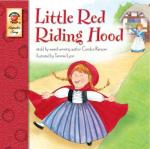
Essay compares the different versions of Little Red Riding Hood.
Comparing Little Red Riding Hood folktales is a multi tasks operation, which includes many elaborations on the many aspects of the story. Setting, plot, character origin, and motif are the few I chose to elaborate solely on. Although the versions vary, they all have the motif trickery, the characters all include some sort of villain with a heroin, the plot concludes all in the final destruction or cease of the villain to be, and, the setting and origins of the versions vary the most to where they are not comparable but only contrastable, if one can say that origins and settings are contrastable.
Little Red Riding Hood retold by the Brothers Grimm version by Paul Galdone includes a "sweet little maiden" (Galdone 1) who never wears anything else but a little red velvet cloak, given to her by her Grandmother. Little Red Riding Hood's mother asks her to take cake and a bottle of wine to her Grandmother. The wolf in the woods is very talented as in she is somewhat convincing in the story. She first approaches Little Red Riding Hood in the woods keeping her calm with polite conversation and convinces her then to pick the beautiful flowers, meanwhile, she scurried away to Grandmother's cottage to devour Grandmother; later to devour Little Red Riding Hood. The wolf later lay there in Grandmother's bed convincingly as Grandmother in Grandmother's cap down over her face. After convincing Little Red Riding Hood to approach the wolf then devours her. The heroin turns out to be a huntsman, whom "took a knife and began cutting open the sleeping wolf" (Galdone 26) when out popped Little Red Riding Hood and Grandmother. Little Red Riding Hood is victorious by putting all inside the wolf big stones, which weighed him down, and, eventually, he died. The huntsman gained the hide of the wolf. All the action takes place in the daytime near the wood. The motif of the story is the wolf's trickery. The origins and culture are the simply the basics.
Lon Po Po version by Ed Young characters includes a mother, three daughters, a wolf and, only introductions of Grandmother. This version differs greatly by the fact that Grandmother is not sick like the original, it's Grandmother's birthday and "the good mother set off to see her, leaving the three children at home" (Young 2). Unlike the original, too, this is taking place on a dark night. The wolf uses trickery but the eldest girl is very clever which then the wolf eventually gets mislead. They mislead the wolf, "climbed up the tall tree" (Young 16) in retreats of the gingko nuts. The girls eventually kill the wolf by dropping him in the basket they were pulling up by rope, which was intentional. The origins and culture are significantly Chinese. The motif is the trickery yet again only in a different manner.
Petite Rouge Riding Hood version by Mike Artell includes characters that are animals. What would be humans in the original Little Red Riding Hood, are ducks in this version, with a mother, daughter, grandmother, and the villain, instead of the evil wolf, is now a gator. The girl, Petite Rouge Riding Hood, has a companion cat. This version takes places near and on the swamp. The condiments needed to take to the grandmother to help with her flu are gumbo and boudin. The grandmother is not eaten in this version; the grandmother hides in the closet until she feels it is safe to come out. This version yet again has the motif of trickery, by means of the gator posing as the grandmother in bed. The cat is the heroin by means of the hot sauce. And yet you would think the motif of trickery is alone the gator, it is most certainly not for Petite Rouge Riding Hood and the cat have tricked the gator into thinking all grand-mere, little girls, and cats are hot to the bite. The origins of this book came from the Cajun people who were earlier known as Acadians. They spoke French and moved to Louisiana to the shores of Bayou Teche near Lafayette. (Artell)
Little Red Cowboy Cat version by Susan Lowell is a western. This story takes place on a ranch and canyon. The characters are the mother, girl, with the red cowboy hat, the grandmother, the wolf, and also a buckskin pony. The condiments being taken to the girl's sick in bed grandmother include a loaf of bread and a jar of jelly. The motif is trickery yet again. Although the wolf doesn't do too well in the canyon in tricking red, he almost tricks her while posing as grandmother in the bed. Little Red is smart and knows that the wolf is posing as grandmother in taking a closer look. But the twist in the end of this version is that Grandmother had been out cutting wood and comes in just in time to save the day. Grandmother and Little Red run the wolf straight out of the ranch. And the end they enjoy the condiments brought from home. (Lowell)
The motifs are all trickery the villain tricks the innocent and the heroin dominates and wins the situation over. The settings vary significantly but vary to give the story meaning towards its origins. The plots are somewhat similar whereas the innocent come into contact with the villain, where the villain is always the loser. The characters always include the villain and the heroin. There will always be a way of contrasting folktales that have different versions, it's up to the students whom acquire the assignment of actual comparing and contrasting to actually literally achieve that tasks given.
Works Cited
Artell, Mike. Petite Rouge: A Cajun Red Riding Hood. New York: Dial Books for Young Readers. 2001.
Galdone, Paul. Little Red Riding Hood. New York: McGraw-Hill Book Company. 1974.
Lowell, Susan. Little Red Cowboy Hat. New York: Henry Holt and Company. 1997.
Young, Ed. Lon Po Po: A Red-Riding Hood Story from China. New York: Philomel Books. 1989.
This is the complete article, containing 999 words
(approx. 3 pages at 300 words per page).

