
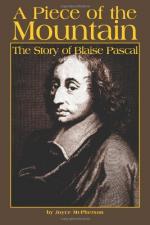
Pensées written by Blaise Pascal is an interesting piece of work, both philosophically and literally, to read. To better understand the reasoning behind the why's and what's of the various reflections regarding Christianity and theology, the development of Pascal's life needs to be briefly looked at. Pascal was born into an educated and wealthy family on June 19, 1623. His father, Étienne, a trained lawyer, held the post of President of the Court of Aids at Claremont and his dutiful mother, Antoinette Bégon, died in 1626, leaving the three children to be cared for by their father. Étienne sold the work post in 1631, moved to Paris and began educating Blaise using a method, which "was to keep the child always in advance of his work." Blaise was first taught to think for himself motivated by the observations, questions, and conversation of his father. By age twelve, Blaise began studying geometry by himself and allegedly achieved the equivalent of Euclid's first thirty-two theorems before his father ascertained his precocity (Hutchins v). Since Étienne's circle of associates included eminent men in science and the arts, Blaise was introduced to and became acquainted with Desargues, Fermat, and Roberval. Although Blaise's health began to falter because of the intensive nature of his intellectual work, he was still able to achieve greater recognition and reputation with the invention of the first calculating machine, which we now call the calculator.
While Blaise and his family were regular and respectful in the religious practice, religion was not of the utmost importance to them until 1646 when they were acquainted with the Jansenist view of Catholicism. Pascal, at twenty-three years old, was influential enough to convert the whole family to Jansenism. The death of his father, Étienne, in 1651 was a turning point of life for both Blaise and his sister, Jacqueline, who renounced the world and entered the Port Royal convent. Blaise, then, turned his attention towards religious and theological questions while pursuing his scientific and mathematical researches. While puzzling over a problem posed by De Méré concerning the division of stakes in a game of chance, Blaise investigated the theory of probability and his results appeared in 1654 in the correspondence with Fermat and also published in the Treatise on the Arithmetical Triangle.
Despite Blaise's success in the scientific and mathematical world, he began feeling "an extreme aversion for the beguilements of the world" by 1654 upon observing the differences of life between Jacqueline's life at Port Royal and his own existence. On November 23, 1654, Blaise choice to retire was known as his "second conversion". He wore as an "amulet", from that point on, the written memoirs, which recorded that from ten-thirty until twelve-thirty that night he knew "the God of Abraham, God of Isaac, God of Jacob, not of philosophers and scientists" and the resolution to have "total submission to Jesus Christ and to my director".
Although he retreated to Port Royal, he did not truly become one of Port Royal's solitaries as his sister had, but was readily identified with its interests. When the Sorbonne condemned the official theologian of Port Royal, Antoine Arnauld, in 1655, Blaise began the Provincial Letters in an effort to enlist public opinion for the Jansenists against the Jesuit adversaries. These letters captivated Paris, from January 1656 to April 1657, by the style and polemic. As death approached, Pascal's life became more austere; he gave his possessions to the poor and continually strove for complete detachment form his loved ones. As he had written on a paper he always kept with him "It is unjust that anyone should attach himself to me...for I am not an end and aim of anyone".
Blaise Pascal began reading and collecting material for what he had planned to be an Apology for the Christian Religion. He wrote down "a few words and very often parts of words only" which at the time were his thoughts on scraps of pieces of paper after the cure of his sister at Port Royal in 1656 known as the Miracle of the Holy Thorn. The fragments, found after his death, collectively compose what is known as his Pensées.
Some of the more interesting ones are included in Sections One through Sections Three. Such as "Do you wish people to believe good of you? Don't speak." No matter what is said or how it is said, there will always be someone who will not correctly interpret the meaning. Another is "Our natures consists in motion; complete rest is death." During our living and breathing lives, we as people do not really stop and rest until death. Even in sleep, we are thinking, breathing, and our hearts are beating to keep us alive. "A mere trifle consoles us, for a mere trifle distresses us." We can find the simplest thing to enjoy, but we can also find the simplest thing to worry about. The one that had the most impact is "Between us and heaven or hell there is only life, which is the frailest thing in the world." Life is often taken for granted by any one person at any one time. We should enjoy life but be aware that there is that thin line between life and death which parallels the thin line between heaven and hell. In reading Blaise Pascal's Pensées, insight is given into his life and thoughts as he approached death. His demand for complete detachment from loved ones could reflect his own insecurity of what was to happen. Rather than have his loved ones mourn over losing him, he chose have them "lose" him rather than have them "lose" him involuntarily.
This is the complete article, containing 952 words
(approx. 3 pages at 300 words per page).

