
Summary:
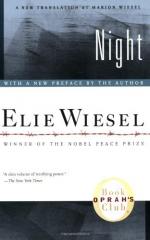
This deals whith the book Night by Elie Wiesel and explains whether Night is an historical piece of literature.
Imagine reading a book about the Holocaust that have someone want to read more, due to the descriptive graphics and how the book sometimes leaves one in suspense. Besides the fact that the content of the book is fantastic something that may have one wanting to read more is that the book uses terrific narratives and they are used throughout the book. A narrative is an account of a story. A book that has plenty of different narrative elements is the book Night by Elie Weisel. The author, Elie Weisel, uses the elements, Since of immediacy- to rush time, Sense of Reality- to make seem real, and Sense of movement- to show movement, to express the story in a whole new way, read along to learn more.
One element of narration is Sense of Immediacy, which means people or time are being rushed or are happening at a fast pace. An author may use this element in his writing to show the importance of time. In the book Night, time is very valuable. Everything needs to be done in an orderly fashion, except sometimes everything can get hectic. When Elie first makes it to their destination (concentration camp) the soldiers really wanted them to hurry up. All the people can hear is guards screaming, "Everybody gets out! Everyone out of the wagon! Quickly!"(26). Elie jumps out of the wagon quickly. At this point in time he is sure that problems were not going to be as excellent as he thought. Unexpectedly he is correct. " Strip! Fast! Los! Keep only your belts and shoes in your hands...."(32) First they are separated from their family and know this, being robbed of maybe your best outfit. Who ever said that this was a better place, must have not been a Jew. Maybe the Jews noticed that at the concentration camps they would not be having a blast from when the soldiers would yell " All Jews outside! Hurry!" (13) When they left the ghettoes. The soldiers hear many sounds along with babies crying " Water! Mummy! Water!" (14). Many people think that going to the ghettoes or the concentration camps are going to be a better place because that is what some Germans stated. They hear many first hand stories from people who experienced this, but they do not believe. Now this is their turn to face the harsh reality.
When the reader can imagine being where the author is describing, or almost seeing what is happening, the reader is experiencing Sense Of Reality. Elie is sent to the ghettos and concentration camp where the Jews noticed that were going to be in for a big surprise. The Jewish children even have big surprise when they are thirsty, and crying" Water! Mummy! Water!"(14) Along with being thirsty, they begin to get exhausted with marching. They encourage their selves to continue by saying " We must keep going, we must keep going."(18) The two examples mentioned shows that they are seeing how much the people do not like them, because they were being tortured, sent to gas chambers or as they say " Showers", starved, and burned in the crematories. This also shows that the soldiers, and Hitler do not care how old you are, but if you are Jew you were going to be most likely killed. These quotes were so realistic that the reader could almost imagine their self actually being they're hearing the children cry, and the people encouraging them. When their camp is bombed everyone scatters for safety. During the bombing one of the prisoners sneak and eat soup, soon he and others are hung. They made an example of them. A passage read, " Cover your heads! Then the march past began. The two adults were no longer alive. Their tongues hung swollen, blue-tinged. But the third rope was still moving; being so light, the child was still alive..."(61-62) That quote makes the reader feel as if you are watching the boy be hung right in front of your eyes. Weisel used such fantastic description words so it made it as if you could see the dead adults hanging from the rope. From time to time they would have to travel a maximum of forty-seven miles to reach their new destination. They had to critically move from place to place, and many people died during this movement.
Movement is when the author shows something traveling from one place to another. Movement is very important in Night. It lets the reader further understand what is being described in the story by sowing down the movement. Throughout the beginning of the book, moving was part of the Jews life. They move from there home to the ghettoes to the synagogue to the train and then to the concentration camps. (3) Whenever they travel they usually march, no matter if it is raining, snowing, extra cold or hot the Nazis make them march. Before the transportation of the people to the ghettos there was movement. " On the Saturday before Pentecost, in the spring sunshine, people strolled, carefree and unheeding, through the swarming streets. They chatted happily. The children played games on the pavements. With some of my schoolmates, I sat in the Ezra Malik gardens, studying a treatise on the Talmud."(10) Before the Germans came and took over the Jews they were having a happy life. Kids always moved from place to place and interacted with the other students. The Jews do many of moving in the concentration camp alone. Their day consisted of " Standing. Counting off. Sitting down. Standing up again. On the ground once more. Endlessly. We waited impatiently to be fetched. What are they waiting for? At last the order came: Forward March!"(16) This was so much movement that it would get you tired. This was maybe one of the reasons that so many people at the concentration camp were extra skinny: they hardly ate, and then they did plenty of movement. Some of their movements included running during selections."...Do not walk slowly, run! Run as if the devil were after you! Do not look at the SS. Run, straight in front of you!"(67) Selections were used to distinguish the weak from the strong. The selections were very hard to pass. Imagine having to run really fast if you're weak and hardly eat anything. This was a hard process and only the strongest survived.
Throughout the book Night many elements of narratives are used. For example some mentioned: Sense of Immediacy, Sense of Reality, and Movement. Due to all of these elements that makes Night a historical piece of narration.
Work Cited Page
Night By: Elie Weisel
"Quote"(Page #)
"Everybody get out! Everyone out of the wagon! Quickly!"(26).
" Strip! Fast! Los! Keep only your belts and shoes in your hands... ."(32)
" All Jews outside! Hurry!" (13)
" Water! Mummy! Water!" (14)
" We must keep going, we must keep going."(18)
" Cover your heads! Then the march past began. The two adults were no longer alive. Their tongues hung swollen, blue-tinged. But the third rope was still moving; being so light, the child was still alive..."(61-62)
" On the Saturday before Pentecost, in the spring sunshine, people strolled, carefree and unheeding, through the swarming streets. They chatted happily. The children played games on the pavements. With some of my school mates, I sat in the Ezra Malik gardens, studying a treatise on the Talmud."(10)
" Standing. Counting off. Sitting down. Standing up again. On the ground once more. Endlessly. We waited impatiently to be fetched. What are they waiting for? At last the order came: Forward March!"(16)
"...Do not walk slowly, run! Run as if the devil were after you! Do not look at the SS. Run, straight in front of you!"(67)
This is the complete article, containing 1,292 words
(approx. 4 pages at 300 words per page).

