
 Print
Print Word
Word PDF
PDF“Look here, Frome,” I began, “there’s no earthly use in your going any farther-” but he interrupted me: “Nor you neither. There’s been about enough of this for anybody.”
I understood that he was offering me a night’s shelter at the farm, and without answering I turned into the gate at his side, and followed him to the barn, where I helped him to unharness and bed down the tired horse. When this was done he unhooked the lantern from the sleigh, stepped out again into the night, and called to me over his shoulder: “This way.”
Far off above us a square of light trembled through the screen of snow. Staggering along in Frome’s wake I floundered toward it, and in the darkness almost fell into one of the deep drifts against the front of the house. Frome scrambled up the slippery steps of the porch, digging a way through the snow with his heavily booted foot. Then he lifted his lantern, found the latch, and led the way into the house. I went after him into a low unlit passage, at the back of which a ladder-like staircase rose into obscurity. On our right a line of light marked the door of the room which had sent its ray across the night; and behind the door I heard a woman’s voice droning querulously.
Frome stamped on the worn oil-cloth to shake the snow from his boots, and set down his lantern on a kitchen chair which was the only piece of furniture in the hall. Then he opened the door.
“Come in,” he said; and as he spoke the droning voice grew still...
It was that night that I found the clue to Ethan Frome, and began to put together this vision of his story.
I
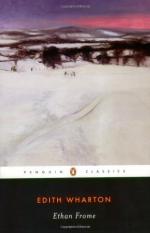
The village lay under two feet of snow, with drifts at the windy corners. In a sky of iron the points of the Dipper hung like icicles and Orion flashed his cold fires. The moon had set, but the night was so transparent that the white house-fronts between the elms looked gray against the snow, clumps of bushes made black stains on it, and the basement windows of the church sent shafts of yellow light far across the endless undulations.
Young Ethan Frome walked at a quick pace along the deserted street, past the bank and Michael Eady’s new brick store and Lawyer Varnum’s house with the two black Norway spruces at the gate. Opposite the Varnum gate, where the road fell away toward the Corbury valley, the church reared its slim white steeple and narrow peristyle. As the young man walked toward it the upper windows drew a black arcade along the side wall of the building, but from the lower openings, on the side where the ground sloped steeply down to the Corbury road, the light shot its long bars, illuminating many fresh furrows in the track leading to the basement door, and showing, under an adjoining shed, a line of sleighs with heavily blanketed horses.





