
 Print
Print Word
Word PDF
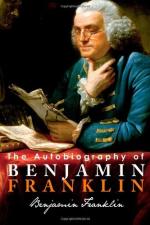
PDFTitle: The Autobiography of Benjamin Franklin
Author: Benjamin Franklin
Release Date: July, 1994 [EBook #148]
[This file was last updated on January 19, 2005]
Edition: 11
Language: English
Character set encoding: ASCII
*** Start of the project gutenberg EBOOK autobiography of Benjamin Franklin ***
THE AUTOBIOGRAPHY OF BENJAMIN FRANKLIN
With introduction and notes
edited by Charles W Eliot LLD
P F Collier & son company, new
York (1909)
INTRODUCTORY NOTE
Benjamin Franklin was born in Milk Street, Boston, on January 6, 1706. His father, Josiah Franklin, was a tallow chandler who married twice, and of his seventeen children Benjamin was the youngest son. His schooling ended at ten, and at twelve he was bound apprentice to his brother James, a printer, who published the “New England Courant.” To this journal he became a contributor, and later was for a time its nominal editor. But the brothers quarreled, and Benjamin ran away, going first to New York, and thence to Philadelphia, where he arrived in October, 1723. He soon obtained work as a printer, but after a few months he was induced by Governor Keith to go to London, where, finding Keith’s promises empty, he again worked as a compositor till he was brought back to Philadelphia by a merchant named Denman, who gave him a position in his business. On Denman’s death he returned to his former trade, and shortly set up a printing house of his own from which he published “The Pennsylvania Gazette,” to which he contributed many essays, and which he made a medium for agitating a variety of local reforms. In 1732 he began to issue his famous “Poor Richard’s Almanac” for the enrichment of which he borrowed or composed those pithy utterances of worldly wisdom which are the basis of a large part of his popular reputation. In 1758, the year in which he ceases writing for the Almanac, he printed in it “Father Abraham’s Sermon,” now regarded as the most famous piece of literature produced in Colonial America.
Meantime Franklin was concerning himself more and more with public affairs. He set forth a scheme for an Academy, which was taken up later and finally developed into the University of Pennsylvania; and he founded an “American Philosophical Society” for the purpose of enabling scientific men to communicate their discoveries to one another. He himself had already begun his electrical researches, which, with other scientific inquiries, he called on in the intervals of money-making and politics to the end of his life. In 1748 he sold his business in order to get leisure for study, having now acquired





