
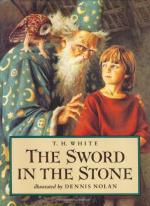
T. H. White has made … the same assumption which [Leo] Tolstoy made in writing War and Peace: that there are no essential differences between historical characters and people living to-day. For that reason The Sword in the Stone is not just a boy's book about monsters, or a funny book about knights in armour, nor a purely whimsical book like Kenneth Graeme's Wind in the Willows. It has something in common with all these, but has the life and solidity that they lack. The best bits of it indeed are the direct descriptions of nature, of country life, of the behaviour and appearance of bird, beast, and fish. Like Tolstoy, still more like Rostov [of War and Peace], or Levin [of Anna Karenina], White has a passion for all country sports and crafts. He can describe haymaking because he has obviously worked in the hayfield, or an owl eating a mouse, because he has fed owls on mice. Thus he enters into the soul of a hawk, of a grass-snake, of a badger, of a fish, because he has kept them, tamed them, spent months of his life learning to know them. It is not idle whimsicality which leads him to translate their characters into terms which all his readers may understand, but poetic insight. He has thus without magic equipped himself to describe Arthur's training as though he himself had been Merlin's pupil. It will be remembered that Arthur was turned into a fish, a bird, etc. These chapters in The Sword in the Stone show, in my opinion, real poetic imagination which is all the more moving because they are broken up by passages of great comic buffoonery….
Predictions are rash: but The Sword in the Stone should be enormously popular and become one of those curious classics of English literature which are as much part of the lives of grownup people as of their children. I do not wish to give the impression that I think it perfect. It is frequently commonplace and there are two quite bad chapters: the ruthless extermination of the anthropophagi by Robin Hood's men who cannot (even with the help of Lord Lilford) be got into the same continent as the poor Sciopods and pigmies. And there is a visit to the Fascist giant's castle who beats his prisoners with rubber truncheons—but yet fails to be a convincing giant. Perhaps the reason is that T. H. White has kept goshawks and merlins and badgers and grass snakes, and looked into their souls and loved them, but has never been in a concentration camp or known a torturer. On the other hand, his boar hunt is good and exactly corresponds to my memories of the hunts to which I was taken by a French postman—yet I strongly suspect that Mr. White hasn't hunted wild boars. In any case his description of tilting sounds as though he had spent years training for it and had given it up in disgust….
This is a free excerpt of 496 words. There are 541 words (approx.
2 pages at 300 words per page) in the full critical essay.
Read the rest of this Criticism with our White, T(erence) H(anbury) 1906–1964: Critical Essay by David Garnett Access Pass.

