
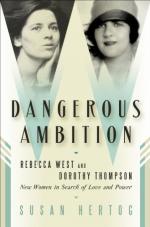
The Fountain Overflows is Miss Rebecca West's first novel for twenty-one years and is indeed only her sixth work of fiction. That this should be so is no doubt the price she has had to pay for her versatility as a writer. Are we to think of her primarily as a brilliant reporter, a great journalist? That she certainly is. But during her career as a writer she has played many parts: she has been, among other things, an admirable literary critic and a wonderfully astringent reviewer. Yet the publication of The Fountain Overflows proves that what she is above all, and what she ought to be, is a novelist; and in the light of this new novel, it is impossible not to regret her long years of absence from fiction.
It is not news that Miss West possesses a most formidable intelligence. Intellectually, she is, one feels, armed at all points; and though a formidable intelligence is not the first requisite of a novelist, other things being equal he will be a better novelist for having it. In point of fact, Miss West's early novels were not quite satisfactory as novels. She was one of the first English authors to grasp the value of psycho-analysis as part of the novelist's necessary equipment towards the understanding of human nature. In her earlier fiction, however, the formal element of psycho-analysis is altogether too obtrusive, so much so that The Return of the Soldier, her first novel, now reads like a dramatization of a case-history. In a too overt illustration of the working of the Oedipus Complex, it finally ruins her second novel, The Judge. Yet The Judge remains a work of real interest and distinction; it announces in character and theme some of its author's abiding preoccupations. First, there is the character of the heroine. However the novel may fail at the end, Ellen Melville is surely one of the most striking representations in all English fiction of a young woman. She is as passionate and as sure of herself as a Brontë heroine….
This is a free excerpt of 342 words. There are 1,480 words (approx.
5 pages at 300 words per page) in the full critical essay.
Read the rest of this Criticism with our West, Rebecca 1892–1983: Critical Essay by The Times Literary Supplement Access Pass.

