
BookRags.com Literature Guides Literature Guides Criticism/Essays Criticism/Essays Biographies Biographies My Bibliography Periodic Table U.S. Presidents Shakespeare Sonnet Shake-Up
Research Anything:        
History | Encyclopedias | Films | News | Create a Bibliography | More... Login | Register | Help
Not What You Meant?  There are 44 definitions for Evelyn.  Also try: Love Among the Ruins or Blackhouse.


Waugh, Evelyn 1903–1966: Critical Essay by Edmund Wilson

Print-Friendly  Order the PDF version  Order the RTF version
About 5 pages (1,529 words)
Evelyn Waugh Summary

Bookmark and Share

Nothing can taste staler today than some of the stuff that seemed to mean something [at the end of the twenties], that gave us twinges of bitter romance and thrills of vertiginous drinking. But The Great Gatsby and The Sun Also Rises hold up; and my feeling is that [Waugh's novels of the period] are the only things written in England that are comparable to Fitzgerald and Hemingway. They are not so poetic; they are perhaps less intense; they belong to a more classical tradition. But I think that they are likely to last and that Waugh, in fact, is likely to figure as the only first-rate comic genius that has appeared in English since Bernard Shaw.

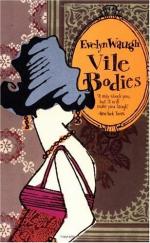
The great thing about Decline and Fall, written when the author was twenty-five, was its breath-taking spontaneity. The latter part of the book leans a little too heavily on Voltaire's Candide, but the early part, that hair-raising harlequinade in a brazenly bad boys' school, has an audacity that is altogether Waugh's and that was to prove the great principle of his art. This audacity is personified here by an hilarious character called Grimes. Though a schoolmaster and a "public-school man," Grimes is frankly and even exultantly everything that is most contrary to the British code of good behavior…. This audacity in Waugh's next book, Vile Bodies, is the property of the infantile young people who, at a time "in the near future, when existing social tendencies have become more marked," are shown drinking themselves into beggary, entangling themselves in absurd sexual relationships, and getting their heads cracked in motor accidents. The story has the same wild effect of reckless improvisation, which perfectly suits the spirit of the characters; but it is better sustained than Decline and Fall, and in one passage it sounds a motif which for the first time suggests a standard by which the behavior of these characters is judged: the picture of Anchorage House with its "grace and dignity and other-worldliness," and its memories of "people who had represented their country in foreign places and sent their sons to die for her in battle, people of decent and temperate life, uncultured, unaffected, unembarrassed, unassuming, unambitious people, of independent judgment and marked eccentricities."

This is a free excerpt of 371 words. There are 1,529 words (approx. 5 pages at 300 words per page) in the full critical essay.

Read the rest of this Criticism with our Waugh, Evelyn 1903–1966: Critical Essay by Edmund Wilson Access Pass.

Copyrights
Waugh, Evelyn 1903–1966: Critical Essay by Edmund Wilson from Literature Criticism Series. ©2005-2006 Thomson Gale, a part of the Thomson Corporation. All rights reserved.

Join BookRagslearn moreJoin BookRags


About BookRags | Customer Service | Report an Error | Terms of Use | Privacy Policy

