
BookRags.com Literature Guides Literature
Guides
Criticism & Essays Criticism &
Essays
Questions & Answers Questions &
Answers
Lesson Plans Lesson
Plans
My Bibliography Periodic Table U.S. Presidents Shakespeare Sonnet Shake-Up
Research Anything:        
History | Encyclopedias | Films | News | Create a Bibliography | More... Login | Register | Help

Not What You Meant?  There are 4 definitions for The Color Purple.  Also try: Purple or Sofia.

Walker, Alice 1944–: Critical Essay by Peter S. Prescott

Print-Friendly  Order the PDF version  Order the RTF version
Alice Walker
About 2 pages (597 words)
The Color Purple Summary

Bookmark and Share Know this topic well? Help others and get FREE products!

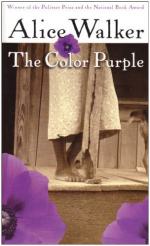
Because I have an eerie feeling that any attempt I make to describe what happens in this story is likely to start the summer rush for the beaches, I want to say at once that "The Color Purple" is an American novel of permanent importance, that rare sort of book which (in Norman Mailer's felicitous phrase) amounts to "a diversion in the fields of dread." Alice Walker excels at making difficulties for herself and then transcending them. To cite an example: her story begins at about the point that most Greek tragedies reserve for the climax, then becomes by immeasurably small steps a comedy which works its way toward acceptance, serenity and joy. To cite another: her narrative advances entirely by means of letters that are either never delivered or are delivered too late for a response, and most of these are written in a black English that Walker appears to have modified artfully for general consumption. (p. 67)

The letters begin with Celie addressing herself to God because she's ashamed to tell anyone else. Celie is black, ugly, not good at school work; she lives in rural Georgia in this century's second decade and is 14 when the man she takes to be her father begins to rape her. She bears this man two children, who are taken away; at his insistence, she marries a man who would rather have had her younger sister, Nettie. Others call Celie's husband Albert, but she cannot; unable to muster his name in her letters, she calls him "Mr.—." "You black, you pore, you ugly," Albert tells his wife, "you a woman … you nothing at all." Albert invites to their home his old mistress, a blues singer named Shug Avery, who arrives ill, with "the nasty woman disease." This event, which should break up any household, proves oddly restorative; a bond between Celie and Shug develops, almost to the exclusion of the useless Albert.

This is a free excerpt of 321 words. There are 597 words (approx. 2 pages at 300 words per page) in the full critical essay.

Read the rest of this Criticism with our Walker, Alice 1944–: Critical Essay by Peter S. Prescott Access Pass.

Ask any question on The Color Purple and get it answered FAST!
Answer questions in BookRags Q&A and earn points toward
discounted or even FREE Study Guides and other BookRags products!
Learn more about BookRags Q&A
Copyrights
Walker, Alice 1944–: Critical Essay by Peter S. Prescott from Literature Criticism Series. ©2005-2006 Thomson Gale, a part of the Thomson Corporation. All rights reserved.


Join BookRagslearn moreJoin BookRags


About BookRags | Customer Service | Report an Error | Terms of Use | Privacy Policy

