
 Print
Print Word
Word PDF
PDF|
This section contains 2,583 words (approx. 9 pages at 300 words per page) |

|
It is a growing awareness of the seriousness of Vonnegut's inquiries which has made people realize that he is not only the science fiction writer he first appeared to be.
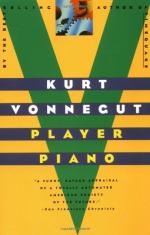
His first novel, Player Piano (1952), was, to be sure, a fairly orthodox futuristic satire on the dire effects on human individuality of the fully mechanised society which technology could make possible. A piano player is a man consciously using a machine to produce aesthetically pleasing patterns of his own making. A player-piano is a machine which has been programmed to produce music on its own, thus making the human presence redundant. This undesirable inversion of the relationship between man and machine, suggested by the title, is at the heart of the novel. In this society of the future there is one part for the machines and the managers, and another part ('the Homestead') into which have been herded...
|
This section contains 2,583 words (approx. 9 pages at 300 words per page) |
|



