
BookRags.com Literature Guides Literature
Guides
Criticism & Essays Criticism &
Essays
Questions & Answers Questions &
Answers
Lesson Plans Lesson
Plans
My Bibliography Periodic Table U.S. Presidents Shakespeare Sonnet Shake-Up
Research Anything:        
History | Encyclopedias | Films | News | Create a Bibliography | More... Login | Register | Help


Updike, John (Hoyer) 1932–: Critical Essay by V. S. Pritchett

Print-Friendly  Order the PDF version  Order the RTF version
John Updike
About 3 pages (847 words)
Rabbit Is Rich Summary

Bookmark and Share Questions on this topic? Just ask!

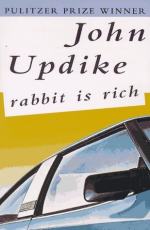
[In "Rabbit Is Rich"] Updike's difficulty is to find a means of insinuating the sins of the past without recapitulating them and to make the novel something more than a job of clearing up. All his astonishing technical virtuosity as a poet, chronicler, moralist, and storyteller is called for. I detect some change of tone, but he has at any rate escaped the journalistic telegraphese that ruined, say, the later "Forsyte" and other sagas. And if "Rabbit Is Rich" is in danger of becoming an essay in latter-day Babbittry, the author does fill out a man ashamed of his shamelessness; Rabbit is shown puzzled by his inescapable Puritan guilts, and relieved by bursts of rancor. As a onetime basketball hero, he has not much more in his head than the ethos of the "achiever": you must "win." Beyond that, he is so cloudy in mind that he never really knows whether, morally speaking, he is lighting out or lighting back. Some critics have called him a monster, but he is far from that. Even in his tiresome sexual obsession he is excusable, having come to sex later than the young do today. He is really a deedy infant, and moderately decent: he'd like to learn. If he doesn't quite know how to love his wife, he is sentimentally protective; in the common love-hate between father and son, he is honest, though his methods are risky. (p. 201)

If we look first of all at Updike as a chronicler, we have to say that he was dead right in choosing the minor provincial city of Brewer, Pennsylvania, and putting Rabbit into the motor trade. That trade is the source of inner-city decay. This kind of ad-hoc city has become international; horrible world news pours in via "the boob tube," and adds new fantasies to what one has to call the "ongoing" private stream of domestic consciousness—one recalls that in Joyce, to whom Updike has a debt, that stream mainly flowed back. The next element is native American, even though it has spread: television's real contribution to the mind comes from the Things in the commercials, with their awful jollities. Updike has the extraordinary gift of making the paraphernalia of, say, the Sears, Roebuck catalogue sound like a chant from the Book of Psalms turned into vaudeville. (p. 202)

This is a free excerpt of 386 words. There are 847 words (approx. 3 pages at 300 words per page) in the full critical essay.

Read the rest of this Criticism with our Updike, John (Hoyer) 1932–: Critical Essay by V. S. Pritchett Access Pass.

Ask any question on Rabbit Is Rich and get it answered FAST!
Answer questions in BookRags Q&A and earn points toward
discounted or even FREE Study Guides and other BookRags products!
Learn more about BookRags Q&A
Copyrights
Updike, John (Hoyer) 1932–: Critical Essay by V. S. Pritchett from Literature Criticism Series. ©2005-2006 Thomson Gale, a part of the Thomson Corporation. All rights reserved.


Join BookRagslearn moreJoin BookRags


About BookRags | Customer Service | Report an Error | Terms of Use | Privacy Policy

