
BookRags.com Literature Guides Literature
Guides
Criticism & Essays Criticism &
Essays
Questions & Answers Questions &
Answers
Lesson Plans Lesson
Plans
My Bibliography Periodic Table U.S. Presidents Shakespeare Sonnet Shake-Up
Research Anything:        
History | Encyclopedias | Films | News | Create a Bibliography | More... Login | Register | Help


Updike, John (Hoyer) 1932–: Critical Essay by Russell Davies

Print-Friendly  Order the PDF version  Order the RTF version
John Updike
About 2 pages (531 words)
Rabbit Is Rich Summary

Bookmark and Share Know this topic well? Help others and get FREE products!

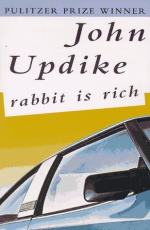
[John Updike's] Rabbit is a big man and partly unaware of his own strength—emotional strength especially—but he is not big enough to build dynasties and oppose time and tide. He knows he is a victim, but he fights on with his remaining powers. Along with those veteran show-people who so often say it, he could claim, and with the same banal justice, that he's 'a survivor'…. [In Rabbit Run and Rabbit Redux Updike's] descriptions of the hypocrisy enshrined in life's furnishings had the glint of an elaborate sadism about them, and sometimes phrases would just take off into horror-poetry not to be treasured at all, except as exemplars of a Fabergé sickliness done into words. But all this is under control [in Rabbit Is Rich]. Updike is still not giving us Toyota economy, but like Detroit, he is trying. No more chromium encrustations and flying fins, at any rate. It is one of the reasons why the novel gives such a satisfying sense of integration.

But the main reason is that Harry Angstrom himself has achieved an accommodation with chaos. One had felt before—and particularly with Rabbit Redux—that Updike was putting him through the mill, that Harry was a demonstration model. Even his name was a set-up chosen for the Angst that was in it. By 1980 Updike and Harry together have got over this. What used to be confrontational in their pain, with flaring scenes and flaring buildings (another of Updike's fondnesses is for arson), has become constant, pervasive. In all this long book there is scarcely a scene you could call violent. Even when Harry's problem-child Nelson smashes one used car into another on the sales lot, this gesture of frustration is made to strike the reader, remarkably, as an understatement. It stands in lieu of worse things said. Harry understands this, and we are grateful for the understanding. (Our feeling of being at home with Harry is not just the familiarity of previous acquaintance: it is gratitude for his not being worse than he is. A gratitude, indeed, which Harry feels himself.)…

This is a free excerpt of 344 words. There are 531 words (approx. 2 pages at 300 words per page) in the full critical essay.

Read the rest of this Criticism with our Updike, John (Hoyer) 1932–: Critical Essay by Russell Davies Access Pass.

Ask any question on Rabbit Is Rich and get it answered FAST!
Answer questions in BookRags Q&A and earn points toward
discounted or even FREE Study Guides and other BookRags products!
Learn more about BookRags Q&A
Copyrights
Updike, John (Hoyer) 1932–: Critical Essay by Russell Davies from Literature Criticism Series. ©2005-2006 Thomson Gale, a part of the Thomson Corporation. All rights reserved.


Join BookRagslearn moreJoin BookRags


About BookRags | Customer Service | Report an Error | Terms of Use | Privacy Policy

