
BookRags.com Literature Guides Literature Guides Criticism/Essays Criticism/Essays Biographies Biographies My Bibliography Periodic Table U.S. Presidents Shakespeare Sonnet Shake-Up
Research Anything:        
History | Encyclopedias | Films | News | Create a Bibliography | More... Login | Register | Help
Not What You Meant?  There are 39 definitions for The Lord of the Rings.  Also try: Miller or LR or LTR or LOR.


Tolkien, J(ohn) R(onald) R(euel) 1892–1973: Critical Essay by Matthew Hodgart

Print-Friendly  Order the PDF version  Order the RTF version
J. R. R. Tolkien
About 3 pages (929 words)
The Lord of the Rings Summary

Bookmark and Share

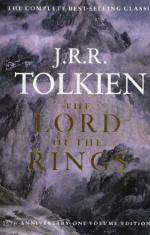
Although I like reading epics, medieval romances, and folktales, for many years I could not get beyond the barrier of that first all-too-Hobbit sentence: "When Mr. Bilbo Baggins of Bag End announced that he would shortly be celebrating his eleventy-first birthday with a party of special magnificence, there was much talk and excitement in Hobbiton." When I forced myself inside I began to read with growing speed and excitement; then went back to The Hobbit (which is a very good children's book); then read most of the Rings for a second time, at first enjoying Tolkien's learning and craftsmanship, but ending up disenchanted….

The war episodes and the spy episodes [in The Lord of the Rings] are beautifully synchronized, with a very precise chronology and no loose ends in the narrative. But although the war is presented in a pastiche of Anglo-Saxon and medieval epic and the spy part is a romantic Quest, the basic form is that of a John Buchan thriller. (p. 10)

Everything [in The Lord of the Rings] resolves itself into a simple conflict between Good and Evil. Drawing with immense skill on the Iliad, the Edda, Beowulf, the Irish epics of Cuchullin and the Tuatha Dé, the Mabinogion, Chrétien de Troyes, and Malory, Tolkien completely changes the spirit of heroic and romantic literature; there recognizable human beings suffer from some of the confusions and ambiguities of real life, but he brings everything down to the black-and-white of the fairy tales. But he goes even further than the fairy tales, where the opposition is usually not between moral good and evil but between the familiar world of men and the uncanny world of nature and the supernatural. That contrast he expresses perfectly in The Hobbit and in the forest episodes of the Rings, but throughout most of the latter he presents a much more radical opposition, which is in fact a theological one, between God and the Devil. For a parallel in medieval literature we must look to works written under the inspiration of Christian doctrine: to the Chanson de Roland, with its straight conflict between good Christians and bad Saracens, or to the oddest and least secular part of Arthurian romance, the Queste del Saint Graal. Somewhere in the background of the war between Gondor and Mordor is the war in heaven as described in Revelations.

This is a free excerpt of 389 words. There are 929 words (approx. 3 pages at 300 words per page) in the full critical essay.

Read the rest of this Criticism with our Tolkien, J(ohn) R(onald) R(euel) 1892–1973: Critical Essay by Matthew Hodgart Access Pass.

Copyrights
Tolkien, J(ohn) R(onald) R(euel) 1892–1973: Critical Essay by Matthew Hodgart from Literature Criticism Series. ©2005-2006 Thomson Gale, a part of the Thomson Corporation. All rights reserved.

Join BookRagslearn moreJoin BookRags


About BookRags | Customer Service | Report an Error | Terms of Use | Privacy Policy

