
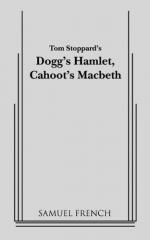
[Dogg's Hamlet] is an elaboration of a minor curiosity called Dogg's Our Pet, and [Cahoot's Macbeth is] fresh evidence that its author is becoming a sort of one-man Amnesty International, with a special interest in his native Czechoslovakia. Little need be said about the first, except that it interjects a comically compressed version of Hamlet into [a] whimsical series of verbal jokes…. 'Cretinous git', says a boy to his headmaster, who nods in gracious acknowledgment. 'Sod the pudding club', smiles a great lady as she hands out the school prizes. Over the interval drinks a jealous rumour spread among my fellow-critics, to the effect that the BBC was in possession of the phrase-book that would explain all; but it hardly seemed worth debagging anyone in hopes of finding it. Anyone who knows his W. S. Gilbert or Monty Python should recognise the sounds of topsyturveydom when he hears them: nothing is what it says, much means the exact opposite.
Cahoot's Macbeth is meatier stuff, though it begins with a characteristic Stoppard joke and follows it with plenty more. Three witches circle a smoking pot in the reddish murk, and salute two noblemen with spears; and then up go the lights, and we're actually and oddly in someone's living room. Macbeth turns out to be the well-known Czech actor Pavel Landovsky, and everyone else a member of the suitcase-theatre that has recently been performing abbreviated classics in Prague houses and tenements, more auspicious auditoria having been refused them by the neo-Stalinists presently in power. Before long it is time for the Porter scene. There are three or four enormous bangs on the door, which then crashes open to reveal a smirking lackey in a belted raincoat who proceeds to needle and threaten everyone present. Noting that the intellectuals watching the performance, like those giving it, are actually employed as janitors, cleaners and the like, he congratulates Landovsky on having 'cracked the problem of the working-class audience'. Reminded of the nominal protection his nation's laws give to human rights, he points out that 'a lot of water has passed through the penal code' since Dubcek. Crack follows crack, most of them funny, all of them malicious. We laugh and feel uncomfortable, as Stoppard, who by now has little left to learn about the uses of humour, presumably means us to do.
This is a free excerpt of 388 words. There are 639 words (approx.
2 pages at 300 words per page) in the full critical essay.
Read the rest of this Criticism with our Stoppard, Tom 1937–: Critical Essay by Benedict Nightingale Access Pass.

