
BookRags.com Literature Guides Literature
Guides
Criticism & Essays Criticism &
Essays
Questions & Answers Questions &
Answers
Lesson Plans Lesson
Plans
My Bibliography Periodic Table U.S. Presidents Shakespeare Sonnet Shake-Up
Research Anything:        
History | Encyclopedias | Films | News | Create a Bibliography | More... Login | Register | Help


Stoppard, Tom 1937–: Critical Essay by Roger Scruton

Print-Friendly  Order the PDF version  Order the RTF version
Tom Stoppard
About 7 pages (1,936 words)
Travesties Summary

Bookmark and Share Know this topic well? Help others and get FREE products!

That self-referential art and self-indulgent revolution grow from the same soil is a proposition with which Tom Stoppard is familiar, and there are few modern playwrights who could bring a more formidable intelligence to bear on it. Stoppard's own plays—which are, almost all of them, plays within plays—grow from the demand that Art should be its own subject. At the same time politics provides their occasion, and no politics fascinates Stoppard more than that which has issued from the revolutionary consciousness.

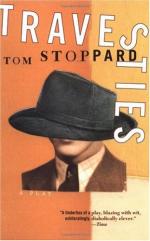
In Travesties (1975), he exploited the accidental, or not-so-accidental, coincidence in Zurich of Tristan Tzara (the arch proponent of the Absolute in Art) and Lenin (the arch political absolutist). With them also is James Joyce, and much of the play—a clever collage made from Oscar Wilde's Earnest, the Ithaca chapter in Ulysses, Lenin's letters and speeches, and Tzara's boyish nonsense—is devoted to the contrast between Dada and Ulysses. There is no doubt whose side Stoppard is on. Joyce's novel, like Tzara's badinage, is supremely conscious of its artistry; but it also justifies every word by a vision of reality, whereas Dada is nothing more than self-advertisement. "If there is any meaning in any of it, it is in what survives as art", says Joyce, who demolishes the talentless self-reference of Dada, but will not deny that it is art, and not life, which is the purveyor of value. But Joyce poses a question: does art have reality because life is its raw material, or does life gain reality from the meanings contained in art? What, in short, is the real thing? Lenin, who stands apart from the other characters, sifting his benighted pedantries, shows the relentlessness of the shadow world. Yet it is not a real world. Lenin's words are dead, unfeeling, a patter of urgencies which occasionally rattles across the stage. Revolution can be translated into slogans, but not into art. Hence, if all meanings must be borrowed from art, revolution remains unmeaning, a seething pool of darkness, always advancing, always betraying, but never real.

This is a free excerpt of 336 words. There are 1,936 words (approx. 6 pages at 300 words per page) in the full critical essay.

Read the rest of this Criticism with our Stoppard, Tom 1937–: Critical Essay by Roger Scruton Access Pass.

Ask any question on Travesties and get it answered FAST!
Answer questions in BookRags Q&A and earn points toward
discounted or even FREE Study Guides and other BookRags products!
Learn more about BookRags Q&A
Copyrights
Stoppard, Tom 1937–: Critical Essay by Roger Scruton from Literature Criticism Series. ©2005-2006 Thomson Gale, a part of the Thomson Corporation. All rights reserved.


Join BookRagslearn moreJoin BookRags


About BookRags | Customer Service | Report an Error | Terms of Use | Privacy Policy

