
BookRags.com Literature Guides Literature
Guides
Criticism & Essays Criticism &
Essays
Questions & Answers Questions &
Answers
Lesson Plans Lesson
Plans
My Bibliography Periodic Table U.S. Presidents Shakespeare Sonnet Shake-Up
Research Anything:        
History | Encyclopedias | Films | News | Create a Bibliography | More... Login | Register | Help

Search "Sartre, Jean-Paul 1905–1980: Critical Essay by William V. Spanos"

Criticism Navigation
 

Sartre, Jean-Paul 1905–1980: Critical Essay by William V. Spanos

Print-Friendly  Order the PDF version  Order the RTF version
Jean-Paul Sartre
About 13 pages (3,988 words)
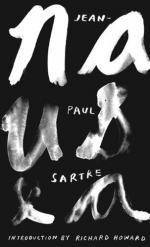
Nausea (book) Summary

Bookmark and Share

La Nausée (1938) is one of the most problematic works of contemporary literature. This is not only because of the uncertainties of its meaning, but also—and more important—because of the uncertainties of its place in the chronology of "modernism." The discussion of these matters is so tangled that it is impossible to categorize it without grossly oversimplifying the issues at stake. It can be said …—and this may be one of the fundamental sources of the uncertainty—that for a long time after the publication of La Nausée, the focus of critical interest fell rather heavily on its "existential" meaning. That is, early "criticism," assuming that the novel was radically autobiographical (i.e. that Sartre and Roquentin are virtually identical), disregarded the formal dimension, more specifically the temporal process of the text—to "explain" its philosophical significance and import. And since the primary thematic emphasis is on Roquentin's agonizing discovery of the viscous realm of existence, it was invariably concluded that Sartre's existentialism at the time of writing La Nausée was limited to a phenomenological description of the contingent realm of existence which is prior to essence, or, more fully, of the alienated, virtually solipsistic, consciousness of the terrible viscosity of the absurd world…. In … failing to develop the hermeneutic lead insisted on by the contrast between the inclusive "Symboliste" novel Roquentin intends to write in the "end"—the novel which will allow him to transcend "the sin of existence"—… most early commentators concealed … the fact that La Nausée, despite Sartre's vestigial metaphysical rhetoric, is ultimately a text about the art of fiction that calls previous modes of composition into question in behalf of a new, a post-Modern, novel. (pp. 223-24)

Unfortunately, these critics have approached Sartre's art from a broadly Modernist hermeneutic perspective. They assume … the ontological priority of Form (Being) over process (temporality) and thus … are blinded by their insight to the post-Modern impulse behind Sartre's refusal of closure, or, more accurately, behind his transformation of closure (the circular narrative) into openness (what Heidegger, after Kierkegaard, calls repetition). Conditioned by the traditional expectation of formal unity, these critics pick up Roquentin's "aesthetic solution" … and develop its implications to conclude with unwarranted finality that La Nausée is a novel whose form is determined by a metaphysics which is prior to Sartre's "radical conversion" and his analogous theory of littérature engagée. They conclude, more specifically, that the novel belongs to the early Modernist tradition. (pp. 224-25)

This is a free excerpt of 406 words. There are 3,988 words (approx. 13 pages at 300 words per page) in the full critical essay.

Read the rest of this Criticism with our Sartre, Jean-Paul 1905–1980: Critical Essay by William V. Spanos Access Pass.

Copyrights
Sartre, Jean-Paul 1905–1980: Critical Essay by William V. Spanos from Literature Criticism Series. ©2005-2006 Thomson Gale, a part of the Thomson Corporation. All rights reserved.


Join BookRagslearn moreJoin BookRags


About BookRags | Customer Service | Report an Error | Terms of Use | Privacy Policy

