
BookRags.com Literature Guides Literature Guides Criticism/Essays Criticism/Essays Biographies Biographies My Bibliography Periodic Table U.S. Presidents Shakespeare Sonnet Shake-Up
Research Anything:        
History | Encyclopedias | Films | News | Create a Bibliography | More... Login | Register | Help
Not What You Meant?  There are 12 definitions for Shame.

Search "Rushdie, (Ahmed) Salman 1947–: Critical Essay by Michael Gorra"

Criticism Navigation
 

Rushdie, (Ahmed) Salman 1947–: Critical Essay by Michael Gorra

Print-Friendly  Order the PDF version  Order the RTF version
Salman Rushdie
About 3 pages (950 words)
Shame (novel) Summary

Bookmark and Share

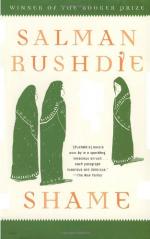
Shame is in some small degree a roman à clef about the relationship between Pakistan's last two dictators, Zulfikar Ali Bhutto and General Zia ul-Haq, but any clef is strictly secondary to Rushdie's consideration of Pakistan itself as a failed act of the imagination. The country's very name is an acronym, he writes, meant to denote the peoples and regions of its western portion—while ignoring the Bengalis who comprised the bulk of its population until the founding of Bangladesh. That irony makes the country's history grotesque from the start, and yet Rushdie hesitates before assaulting it…. "Is history," he asks, in one of the many passages in his own voice interpolated into, and commenting on, Shame's narrative line, "to be considered the property of the participants solely?" Well, perhaps—but if so, Rushdie can take certain liberties with it, can avoid "the real-life material" that would otherwise "become compulsory," in favor of a symbolic version. Rushdie's compromise with history is to write about a country that is "not quite" Pakistan, one that occupies the "same space" but exists at "a slight angle to reality," an angle that gives him the freedom upon which this "modern fairy tale" is predicated…. His prose prances, a declaration of freedom, an assertion that Shame can be whatever he wants it to be, coy and teasing an ironic and brutal all at once. He's been compared to Sterne, but the eighteenth-century novelist who comes to my mind is Fielding. To read Rushdie is to re-experience the novel as novel, as new, to recapture Fielding's claim, in Tom Jones, to be "the founder of a new province of writing [in which] I am at liberty to make what laws I please." Shame is, like Tom Jones, full of narrative games, a fiction about fiction that is nevertheless crammed, and finally most concerned with, the vibrant stuff of life.

Shame, like its predecessor Midnight's Children, hangs on the knife edge between comedy and horror…. If Rushdie never falls off the edge of the knife, the events he describes nearly always do, existing first on one side of it, now on the other. What begins as a joke develops into nightmare. General Hyder's mentally retarded daughter. Sufiya Zinobia, blushes at birth for shame at not having been the boy her parents wanted, and that blush looses the devouring Beast of Shame within her. Shame is for Rushdie a perversion of honor, calls honor's sense of self-worth into question, and attempts to re-assert it through violence. Shame turns Sufiya Zinobia into a more clearly seen version of Midnight's Children's Major Shiva, into a juggernaut, a destroyer…. And as the Beast grows within her, a sense of horror begins, with a Fordian progression d'effet, to supplant the comedy in which Sufiya Zinobia, and the novel as a whole, were born. Pakistan's botched name becomes, in the glow of such destruction, something other than a joke.

This is a free excerpt of 483 words. There are 950 words (approx. 3 pages at 300 words per page) in the full critical essay.

Read the rest of this Criticism with our Rushdie, (Ahmed) Salman 1947–: Critical Essay by Michael Gorra Access Pass.

 
Copyrights
Rushdie, (Ahmed) Salman 1947–: Critical Essay by Michael Gorra from Literature Criticism Series. ©2005-2006 Thomson Gale, a part of the Thomson Corporation. All rights reserved.

Join BookRagslearn moreJoin BookRags


About BookRags | Customer Service | Report an Error | Terms of Use | Privacy Policy

