
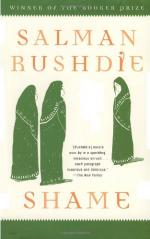
When Midnight's Children appeared a few years ago, Salman Rushdie was "admitted to the ranks," as critics say, of the world's great writers, and those who did the admitting wrote as if a South American writer was suddenly born in the subcontinent. Rushdie seemed condemned to be always compared to García Márquez, and more generally to that kind of inflammation of the imagination, that tropical expressionism, to which a lot of literary taste has surrendered. Magic realism is its latest label. Rushdie surely shares its phantasmagoric ways, its interest in the knowledge that is turned up by delirium, its visionary violence, its appetite for epic and for epic exaggeration. This new novel will show, however, that the acclaim was only approximate. The shock of Shame lies in its fidelity to reality. It is a moderately distorted report on a world that is already deranged. This great English novel of Pakistan asks to be admired not for the richness of its invention, though admiration is plainly deserved, but for the truth of its judgments. It is a reckoning with a whole country and a whole culture; which requires not only language, but courage. Rushdie, then, is a different sort of fantasist. He is not that free. There is more pain than play. The extravagance is an emergency. The novel is more closely stuck to things than its style makes it seem; and it is punctuated with personal and political commentary in which all fictional pretension is dropped. When he calls his manner of writing "off-centering," he is not falsely modest. That is all, alas for those who live in "not quite Pakistan," that it is. For this reason Rushdie recalls Kundera, rather, though he lacks Kundera's metaphysical concentration and his sublime silences. This fairy tale is not the invention of a world but the completion of a world. Here the miraculous is a tool of analysis.
Shame is the story of Pakistan…. The story is wildly comic and wildly cruel, because of the disparity between the scale of Pakistan's history and the scale of the people who determine it. The people, in Rushdie's telling, are small squalid little creatures, "God-absorbed" and perfectly profane, unbecoming to the sacred history of a society. The history, however, is large; indeed, it is too large. Pakistan is "a palimpsest" that leaves Pakistanis with the problem of "what to retain, what to dump." (pp. 32-3)
This is a free excerpt of 398 words. There are 1,058 words (approx.
4 pages at 300 words per page) in the full critical essay.
Read the rest of this Criticism with our Rushdie, (Ahmed) Salman 1947–: Critical Essay by Leon Wieseltier Access Pass.

