
BookRags.com Literature Guides Literature Guides Criticism/Essays Criticism/Essays Biographies Biographies My Bibliography Periodic Table U.S. Presidents Shakespeare Sonnet Shake-Up
Research Anything:        
History | Encyclopedias | Films | News | Create a Bibliography | More... Login | Register | Help
Not What You Meant?  There are 12 definitions for Shame.

Search "Rushdie, (Ahmed) Salman 1947–: Critical Essay by Margo Jefferson"

Criticism Navigation
 

Rushdie, (Ahmed) Salman 1947–: Critical Essay by Margo Jefferson

Print-Friendly  Order the PDF version  Order the RTF version
Salman Rushdie
About 6 pages (1,810 words)
Shame (novel) Summary

Bookmark and Share

Rushdie, born in India, moved first to Pakistan and then to England. In life he is a migrant and exile, in fiction a fantasist and historian. He's a wonderful writer. Midnight's Children, published in 1981, is dense with passion, intelligence, excitement, and every vocal and literary effect conceivable. Shame, his new novel, is also brilliant and risky—not so steadily dazzling, more raw in parts, but just as daring. The rawness is there because Rushdie is always testing the tenets of history, politics, and art; for him, composition is inseparable from intellectual improvisation.

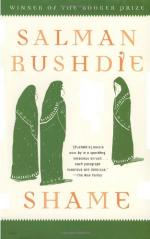
He was born, like Saleem Sinai, narrator of Midnight's Children, in 1947, the year India gained independence from the British and emerged as a new myth—"a collective fiction in which anything was possible, a fable rivaled only by the other mighty fantasies: money and God." Pakistan, Land of the Pure, was born the same year, from religious obsession and political chicanery, its name invented by a group of Muslim intellectuals in England. "To build Pakistan," Rushdie writes in Shame, "it was necessary to cover up Indian history, to deny that Indian centuries lay just beneath the surface of Pakistani Standard Time." This post-colonial world strains the limits of historical reality. Politics mingles with the occult; old feuds and loyalties join new ones. Facts are screened by hopes or lies; spiritualism is draped over ideology. Myths, screens, veils abound in Rushdie's work. The women are continually shrouded in burqas, sheet, dupattas, chadars, garments of womanly honor meant to preserve manly pride….

This is a free excerpt of 251 words. There are 1,810 words (approx. 6 pages at 300 words per page) in the full critical essay.

Read the rest of this Criticism with our Rushdie, (Ahmed) Salman 1947–: Critical Essay by Margo Jefferson Access Pass.

Copyrights
Rushdie, (Ahmed) Salman 1947–: Critical Essay by Margo Jefferson from Literature Criticism Series. ©2005-2006 Thomson Gale, a part of the Thomson Corporation. All rights reserved.

Join BookRagslearn moreJoin BookRags


About BookRags | Customer Service | Report an Error | Terms of Use | Privacy Policy

