
 Print
Print Word
Word PDF
PDF|
This section contains 611 words (approx. 3 pages at 300 words per page) |

|
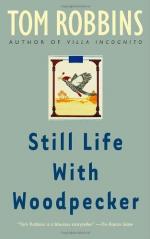
In considering contemporary fiction, John Barth writes, "My own analogy would be with good jazz or classical music: one finds much on successive listenings or on close examination of the score that one didn't catch the first time through; but the first time through should be so ravishing—and not just to specialists—that one delights in the replay." Tom Robbins's Still Life With Woodpecker does not fare well with this kind of test. As witty as the novel is in places, it never becomes more than a clever package of words.
Wrapped up in the package is, the subtitle tells us, "A Sort of a Love Story." A pretty silly one, in fact: an exiled princess falls in love with a commoner who is also an outlaw. Her lover is captured and imprisoned. The princess remains faithful until she misinterprets a message from the outlaw as a...
|
This section contains 611 words (approx. 3 pages at 300 words per page) |
|



