
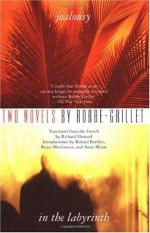
Robbe-Grillet, for all his disavowals, writes novels and films that are simultaneously useful and useless. Like the Tel Quel group, he rejects Sartre's insistence that the artist be committed to a cause beyond art. Art for the "nouveaux romanciers" is, in and of itself, a sufficient cause, and the artist, they feel, need not search for political or social involvement beyond his work. But unlike that of the "nouveaux nouveaux romanciers" Robbe-Grillet's art, even though it is reflexive and does explore the ramifications of the creative process, is, in spite of itself, rooted in reality. It is not a pure exercise in language or optics or structure. While the proponents of non-objective art may claim him, death and eroticism, as two of Robbe-Grillet's main themes, relate too strongly to the world (even though they may not be intended to mirror it), not to involve us in a relationship which postulates interaction. Robbe-Grillet's art occupies a middle ground somewhere between Sartre's extreme commitment of words to reality and the equally extreme linguistic hermeticism of the Tel Quel group….
In Le Voyeur Robbe-Grillet imagines Mathias; Mathias imagines the seduction of Jacqueline. Robbe-Grillet imagines the doctor in Dans le labyrinthe; the doctor imagines the city maze of Reichenfels through which the soldier endlessly walks. Robbe-Grillet imagines Marienbad and his male lead invents a meeting "last year." Robbe-Grillet puts his characters on the Trans-Europ-Express where they invent their roles and adapt them to the continuously shifting demands of each hour, each new encounter, and each new complicating circumstance. Hence all the contradictions, which are not contradictions because everything is imaginary to begin with. L'Homme que ment is about a man who may or may not be telling the truth. It really does not matter and ultimately we do not care whether the things he says or imagines are true or not. What does interest us, if it interests us at all, is the process itself, since we are being asked to watch the imagination build its own reality and then destroy it. (p. 347)
This is a free excerpt of 339 words. There are 2,466 words (approx.
8 pages at 300 words per page) in the full critical essay.
Read the rest of this Criticism with our Robbe-Grillet, Alain 1922–: Critical Essay by Ben Stoltzfus Access Pass.

