
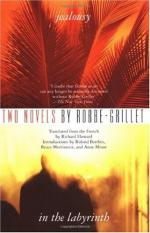
From the outset, the proliferation of game structures in the works of Alain Robbe-Grillet identifies this writer as a notable example of artifex ludens. Almost all the tendencies that were later to be termed "aspects ludiques" in his novels and films may be uncovered by careful scrutiny of his earliest productions. It is even possible to reduce the numerous game structures to a few basic models, such as the circular or winding path of individual cases or rectangles (like those usually found on board games played with dice), the maze or labyrinth, and the multiple-solution type of game, such as Clue, in which shuffling the cards representing characters and places allows each separate partie, although created out of identical elements, to lead to a totally different outcome.
The conception of a fundamentally game-like structure of the novel would make of specific games mentioned in the works, or played by the characters therein, examples of interior duplication, functioning with respect to the over-all structure in somewhat the same way as an "inner novel" (cf. Jealousy) or play (cf. Last Year at Marienbad) that duplicates, at the level of the characters, and within the fictional field, the general pattern of the novel or film. This integrative principle constitutes one type of "justification" of an actual game (as in Marienbad) as coherently incorporated into the esthetic structure. The literal game may be minimized, or may not appear at all; but the "metaphysical" aspect of general game structure cannot, since it is part of the novelistic technique, be avoided. It is in turn this metaphysical implication that protects the work from falling into the gratuity of a neo-Kantian "free play of the faculties" conception of fictional art which might, if pushed to the limit, reduce the creative process to a kind of esthetic billard game or acrobatic display. It is also evident that the problem of formalism in the use of game structures in novels and films has its parallels in painting (from abstract expressionism to Pop Art) and the other arts, especially contemporary music. (pp. 159-60)
This is a free excerpt of 342 words. There are 1,643 words (approx.
5 pages at 300 words per page) in the full critical essay.
Read the rest of this Criticism with our Robbe-Grillet, Alain 1922–: Critical Essay by Bruce Morrissette Access Pass.

