
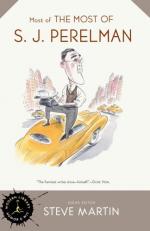
[Only] now, reading The Last Laugh, which appears a year and a half after Perelman's death, have I considered the real, concealed value of his work. Parents could do far worse than to leave The Most of S. J. Perelman lying around the house, because its author demonstrates that it is possible to be funny and write well at the same time, a lesson that is not to be taken lightly in an age when so much humor—whether in print, the movies, or on television—has segregated itself from the literary by its predictability and its graceless pandering to the easy guffaw…. Perelman's sentences, however ornamented or clogged with relative clauses, are as well tailored as were his Savile Row tweeds. His vocabulary is so large as to be fetishistic; it combines the arcane and idiomatic without the sesquipedalian. Even in his lesser pieces, which resemble private gardens overgrown with silly vegetation, the lines are always tended with a Flaubertian care. (p. 37)
Although the autobiographical excerpts [in The Last Laugh] are portraits rendered with typical Perelmanesque finesse … and metaphorical exactitude …, it is the fluttery but well-aimed knuckler, which only looks easy, that Perelman was born to throw. Perelman may have referred to himself as "a species of journalist," but his reportorial genius was for a world located more in his querulous imagination than anywhere else. Newspaper fillers, advertisements, and well wishers supplied him with the bulk of his pieces' comic germs, and The Last Laugh again shows what happens to them after incubating in a mind so fine that every idea violated it. Whether or not Perelman was a true satirist …, his work demonstrates the link between humor and venom; of the latter, he sometimes discharged so much, particularly where Hollywood was concerned, that one occasionally feels the target is being over-complimented.
This is a free excerpt of 304 words. There are 604 words (approx.
2 pages at 300 words per page) in the full critical essay.
Read the rest of this Criticism with our Perelman, S(idney) J(oseph) 1904–1979: Critical Essay by R. D. Rosen Access Pass.

