
BookRags.com Literature Guides Literature
Guides
Criticism & Essays Criticism &
Essays
Questions & Answers Questions &
Answers
Lesson Plans Lesson
Plans
My Bibliography Periodic Table U.S. Presidents Shakespeare Sonnet Shake-Up
Research Anything:        
History | Encyclopedias | Films | News | Create a Bibliography | More... Login | Register | Help

Not What You Meant?  There are 7 definitions for Absalom.  Also try: Cry, the Beloved Country (film).

Paton, Alan (Stewart) 1903–: Critical Essay by Graham Hough

Print-Friendly  Order the PDF version  Order the RTF version
Alan Paton
About 2 pages (597 words)
Cry, The Beloved Country Summary

Bookmark and Share Questions on this topic? Just ask!

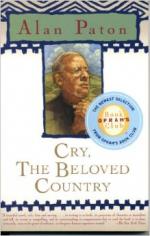
[Paton's Cry, the beloved country] is not merely a social record: it is the deeply imagined story of an individual life. And Paton has had to devise a language to tell the story in, for the simple Zulu parson who is the protagonist does not deal in the current coin of modern English speech. So that the literary question was as demanding as the historical one; the political act cannot be separated from the work of art. Now, after thirty years, comes Ah, but your land is beautiful, with similar themes and settings, the date of the action a few years later, the conflicts more distinctly those of the modern world. And though the continuity with Paton's earlier work is complete, this is a different kind of book. Cry, the beloved country is an exploration both of the racial problem and of personal suffering; and its quasi-Biblical language is a means of penetrating into a sorrowful and bewildered consciousness. Ah, but your land is beautiful is a panorama, a chronicle, with a wide variety of characters and the interest distributed between them. It is a less lyrical and more political book, in part an evident roman-à-clef….

The story unrolls in a series of short episodes, each centred on a single character and the characters covering a wide spectrum of South African life. An Indian girl sits in a 'No Blacks' library and is arrested; a white school official becomes prominent in the Liberal Party; his life is threatened and shots are fired at his house; black farmers in white areas are evicted, their land taken and their houses destroyed; a 'Proud White Christian Woman' writes obscene letters to her political opponents; and an ironic chorus is provided by the correspondence of a petty Afrikaans civil servant, solemnly saluting the progress of apartheid and the triumph of the Nationalist cause. Paton's earlier writing is suffused with a plangent emotion. This is a drier and more objective book, with more variety of tone and manner. Each of the characters has his own style, and the imaginative equitableness we have come to associate with Paton is achieved by presenting each pretty much in his own terms. There is no distinct plot and no defined conclusion—partly because this is to be the first volume of a trilogy, partly because there is no conclusion to be seen….

This is a free excerpt of 391 words. There are 597 words (approx. 2 pages at 300 words per page) in the full critical essay.

Read the rest of this Criticism with our Paton, Alan (Stewart) 1903–: Critical Essay by Graham Hough Access Pass.

Ask any question on Cry, The Beloved Country and get it answered FAST!
Answer questions in BookRags Q&A and earn points toward
discounted or even FREE Study Guides and other BookRags products!
Learn more about BookRags Q&A
Copyrights
Paton, Alan (Stewart) 1903–: Critical Essay by Graham Hough from Literature Criticism Series. ©2005-2006 Thomson Gale, a part of the Thomson Corporation. All rights reserved.

Join BookRagslearn moreJoin BookRags


About BookRags | Customer Service | Report an Error | Terms of Use | Privacy Policy

