
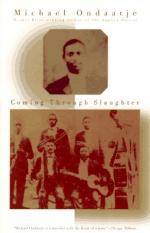
To his acknowledgments at the end of Coming Through Slaughter, Michael Ondaatje adds this final note: "While I have used real names and characters and historical situations I have also used more personal pieces of friends and fathers. There have been some date changes, some characters brought together, and some facts that have been expanded or polished to suit the truth of fiction." He indicates here the intricate mingling of fact, fiction, and personal reference through which he records and invents the life of another of his heroes who sail to that perfect edge: Charles "Buddy" Bolden, a part-time barber and jazz musician in turn-of-the-century New Orleans. Ondaatje uses documents, quotations, and interviews combined with his own songs, poems, and narrative all in the service of the truth of fiction. By blending history and fantasy, he explores the inner life of his subject much as, in an earlier work [The Collected Works of Billy the Kid], he recorded and invented the inner life of Billy the Kid…. The legend of Buddy Bolden is blended even more richly when Ondaatje projects himself into the book. In one section, he describes his first curiosity and sympathy for Bolden who, at the age of 31 (Ondaatje's own age), went berserk while playing in a parade and then spent the rest of his life in a mental hospital. In this way, Ondaatje weaves himself not only into the history, but also into the fantasy of his poetic-novelistic-biography. He makes his own problems as an artist confronting intriguing but intractable material—a "desert of facts" which he must organize, interpret, and bring to a life—a part of the artistry. He draws a parallel between himself and Bolden that emphasizes how all Bolden's frantic struggles with love, music, and madness are part of the same self-perpetuating imaginative conflict. Coming Through Slaughter is a disjointed, though carefully crafted, portrait of the artist; but it is a picture of a particularly volatile artistic temperament. (pp. 126-27)
Buddy Bolden is a worthy addition to Ondaatje's growing list of heroes, and Coming Through Slaughter both deserves and rewards close reading. Because there are so many similarities, it is tempting to compare it with earlier works. Personally, I prefer Billy the Kid. I find its images stronger and more startling, its argument more compelling. A symptom of weakness in Coming Through Slaughter is its preface, consisting of three sonographs, with commentary, of a dolphin's squawks, whistles, and clicks. This is puzzling, as it was certainly intended to be, but not really intriguing. Although we do eventually realize how this fragment fits into the entire mosaic of the book, it is only after some forcing on Ondaatje's part and some impatience on ours, and by then the effect is lost. Other sections also seem too remote or too contrived, understated or over-dramatic. As a result, Bolden himself remains curiously remote, despite all the attention he receives, and never emerges clearly from the "desert of facts," real or fictional, which comprises his life. Granted, we are not supposed to see him clearly—the photo is blurred—but we are supposed to sense and sympathize with the contradictions that torment him, even though these contradictions cannot be resolved. We must appreciate his torment, his agony, even though the man himself remains a mystery. We learn less about Billy, yet care about him more; and not even a single photo survives of him. (pp. 128-29)
Jon Kertzer, in a review of "Coming through Slaughter" (copyright by Jon Kertzer; reprinted by permission of the author), in The Fiddlehead, No. 113, Spring, 1977, pp. 126-29.
This is a free excerpt of 594 words. There are 598 words (approx.
2 pages at 300 words per page) in the full critical essay.
Read the rest of this Criticism with our Ondaatje, (Philip) Michael 1943–: Critical Essay by Jon Kertzer Access Pass.

