
BookRags.com Literature Guides Literature
Guides
Criticism & Essays Criticism &
Essays
Questions & Answers Questions &
Answers
Lesson Plans Lesson
Plans
My Bibliography Periodic Table U.S. Presidents Shakespeare Sonnet Shake-Up
Research Anything:        
History | Encyclopedias | Films | News | Create a Bibliography | More... Login | Register | Help


Odets, Clifford 1906–1963: Critical Essay by John Gassner

Print-Friendly  Order the PDF version  Order the RTF version
About 9 pages (2,700 words)
The Big Knife Summary

Bookmark and Share Questions on this topic? Just ask!

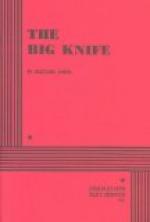
It is no small tribute to Clifford Odets that his return to Broadway after eight years of Hollywood peonage should have roused singular expectations. Although these were not exactly fulfilled in "The Big Knife," it was a relief to learn that his talent had not been eviscerated in Southern California, that he retains his capacity for passion, and that he is still a formidable scene-wright. If one could drive a team of horses through some of the gaps in his argument, if his writing was charged with subjective perversities and non sequiturs, we had reason to be concerned only over the more obvious presence of faults we had tended to overlook in his earlier work. They pertain to his habits of thought and implicate his virtues as well as his vices. They also provide an indispensable basis for any effort to discover why this gifted playwright has not fulfilled the hopes many of us entertained for him, and why his writing is so uneven. (pp. 25-6)

To assume that the author of "The Big Knife" is simply careless or bereft of sense, since he made his own premises, is scarcely tenable. On the contrary, he deliberately chose Hollywood as a symbol for everything deteriorative and unscrupulous in our society; he returned to the "Golden Boy" theme of how a materialistic, success-worshipping world corrupts the soul. He overlooked the weak character of his hero in his zeal to transfer guilt to society; he made equations without considering whether the terms were right. Everything that can be charged to faulty logic and unreality, everything that can be attributed to subjective causes in the play, is implicated in this allegorizing tendency. Odets was off his guard because his eyes were fixed on the horizon. He picked his own pocket while looking for signs above. He dropped some of the change while transferring his money from the pocket of immediate fact to the fancy wallet of social criticism. No wonder his bookkeeping didn't tally. I think that this has been his habit ever since he came to attention as a playwright, and that it is indurated in his intention of writing plays that will have large meaning.

This is a free excerpt of 362 words. There are 2,700 words (approx. 9 pages at 300 words per page) in the full critical essay.

Read the rest of this Criticism with our Odets, Clifford 1906–1963: Critical Essay by John Gassner Access Pass.

Ask any question on The Big Knife and get it answered FAST!
Answer questions in BookRags Q&A and earn points toward
discounted or even FREE Study Guides and other BookRags products!
Learn more about BookRags Q&A
Copyrights
Odets, Clifford 1906–1963: Critical Essay by John Gassner from Literature Criticism Series. ©2005-2006 Thomson Gale, a part of the Thomson Corporation. All rights reserved.

Join BookRagslearn moreJoin BookRags


About BookRags | Customer Service | Report an Error | Terms of Use | Privacy Policy

