
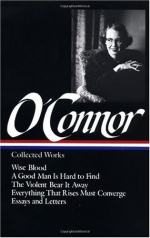
Flannery O'Connor's [The Violent Bear It Away] has a number of immediately striking resemblances, in its religious theme, its Southern setting, its frequently violent or macabre action, and its spiritually tortured characters, both to her short stories, especially those collected in A Good Man Is Hard to Find (1955), and to her first and only other novel, Wise Blood (1952). (p. 11)
Disregarding both the more and less obvious matters for the time being, there are several parallels between [The Violent Bear It Away] and some of Miss O'Connor's other works. Haze Motes in Wise Blood, like Tarwater here, was obsessed first with denying and then with accepting Christ. Harry Bevel in "The River" was drowned in "the water of life," as is Bishop. The relation between the boy and his great-uncle, especially in the flashback recounting a visit by the two to the city, reminds one of "The Artificial Nigger." The fires Tarwater lights are like the one in "Circle in the Fire," in both provocation and significance. Rayber as a rationalist is like Asbury in "The Enduring Chill." Miss O'Connor still uses half-whimsical symbolic names: "Bishop" and "Tarwater," the latter with its implications of dirt and of a panacea, fit neatly into a novel about baptism. Humor is less obtrusive here than in some of her other works (especially Wise Blood and Haze's unforgettable and triumphant "What do I need with Jesus? I got Leora Watts") but this novel has its moments, too; and as usual with Miss O'Connor, comic incongruities rather add to than detract from her seriousness: the great-uncle's monomania for kidnapping and baptizing his infant male relatives is particularly funny. And lastly, some of Miss O'Connor's favorite symbols, sometimes laid on a little thick in other works, reappear here too, and as before they tend to carry two or more opposing meanings simultaneously. Thus, water brings life and death; fire destroys and purifies; eyes reveal and impose purpose; and a physical infirmity (Rayber is deaf) mirrors a spiritual one.
This is a free excerpt of 333 words. There are 2,549 words (approx.
8 pages at 300 words per page) in the full critical essay.
Read the rest of this Criticism with our O'Connor, (Mary) Flannery 1925–1964: Critical Essay by Sumner J. Ferris Access Pass.

