
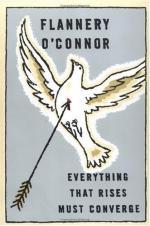
All the characters in the very powerful stories of Flannery O'Connor are abnormal: that is to say they are normal human beings in whom the writer has discovered a relationship with the lasting myths and the violent passions of human life. It would be fashionable in America to call [Everything That Rises Must Converge] Gothic: it certainly has the curious inner strain of fable—replacing the social interest—which is a distinguishing quality of the American novel…. The Southern writers have sometimes tended to pure freakishness or have concentrated on the eccentricities of a decaying social life; but this rotting and tragic order has thrown up strong, if theatrical themes. Flannery O'Connor was born too late to be affected by the romantic and nostalgic legend of the tragic South; the grotesque, for its own sake, means nothing to her. In the story called 'Parker's Back', an absurd truck-driver has indulged a life-long mania for getting tattooed and in a desperate attempt to reawaken the interest of his wife, who had once been captivated by this walking art gallery, he has one final huge tattoo done on his naked back which up till then had been a blank wall. He pays for the most expensive tattoo there is: a Byzantine Christ. She throws him out because on this great deal he has wrecked a tractor. The point of this story is not that it is bizarre; it is that, perhaps because of the confused symbols that haunt the minds of the Bible Belt people, an inarticulate man wishes to convey to her that he has some claim to an inner life. He wishes to show that he is someone. The act is an agonised primitive appeal. It is also an act of defiance and hatred.
The passions are just beneath the humdrum surface in Flannery O'Connor's stories. She was an old Catholic, not a convert, in the South of the poor whites, of the Bible Belt, and this gave her a critical starting-point and skirmishing power, the formative element in American society being Protestant. But the symbolism of religion, rather than the acrimonies of sectarian dispute, fed her violent imagination—the violence is itself rather Protestant, as if she had got something out of the burning, Bible-fed imagery in the minds of her own characters. The symbols are always ominous: at sunset a wood may be idyllic, but also look blood-sodden. They usually precede an act of violence which will introduce the character at the end of the story 'into the world of guilt and sorrow'. This is her ground as a fabulist or moralist. We are left with an illusion shattered, with the chilly task of facing ourselves…. The essence of this artist is that she sees terror as a purification—unwanted, of course: it is never the sado-masochist's intended indulgence. The moment of purification may actually destroy; it will certainly show someone changed.
This is a free excerpt of 479 words. There are 1,128 words (approx.
4 pages at 300 words per page) in the full critical essay.
Read the rest of this Criticism with our O'Connor, (Mary) Flannery 1925–1964: Critical Essay by V. S. Pritchett Access Pass.

