
BookRags.com Literature Guides Literature
Guides
Criticism & Essays Criticism &
Essays
Questions & Answers Questions &
Answers
Lesson Plans Lesson
Plans
My Bibliography Periodic Table U.S. Presidents Shakespeare Sonnet Shake-Up
Research Anything:        
History | Encyclopedias | Films | News | Create a Bibliography | More... Login | Register | Help


Millhauser, Steven 1943–: Critical Essay by Joseph Kanon

Print-Friendly  Order the PDF version  Order the RTF version
About 2 pages (604 words)
Steven Millhauser Summary

Bookmark and Share Questions on this topic? Just ask!

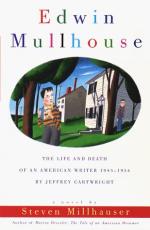
Like great actors in mediocre plays, there are some writers whose talent seems larger than the vehicles they have chosen to contain it. A case in point is [Edwin Mullhouse], a remarkably well-written and sometimes funny account of the hitherto unrecognized genius Edwin Mullhouse…. [The] narrative takes us from Edwin's first gurgles to his creative Later Years and, as such, is a devilish satire on those exhaustive biographies that weigh down shelves with their bulky worthiness and unrelieved tedium. The tone is sly and articulate, as if written by one of Salinger's Glass children, and though the initial idea is admittedly small and even fey, Millhauser makes the most (if not too much) of it, detailing for us the most ordinary of childhoods through Jeffrey's pompous New Crit perspective. (The two boys react to each other like a sinister Holmes and Watson—Edwin makes fun of Jeffrey, whom he rightly sees as a drip, and Jeffrey's underlying resentment and disapproval occasionally come to the narrative surface with quiet hilarity.) (pp. 73, 78)

This kind of elaborate literary conceit, of course, is beloved by academics because it presupposes not only a familiarity with existing literature but a conscious limiting of scope to emphasize verbal dexterity (something Nabokov used to more comic effect in Pale Fire). Millhauser takes some sideswipes at this approach and has some fun dropping pseudopedantic clues. But given his own material, it is all pretty much a case of biting the hand that feeds. The danger in this kind of cerebral writing is an absence of emotion, and Millhauser, alas, runs the familiar gamut from A to B. Certainly he can't be faulted for his fluency and sense of prose style—he can write like a streak—but even the dazzling eventually wearies. Such a lot of cleverness! Detail after detail, send-up after send-up, are piled one on top of another, rococo style, until the structure becomes top-heavy and collapses—a 300-page game. What begins as a satire on exhaustive biographies becomes, itself, an exhausting satire.

This is a free excerpt of 333 words. There are 604 words (approx. 2 pages at 300 words per page) in the full critical essay.

Read the rest of this Criticism with our Millhauser, Steven 1943–: Critical Essay by Joseph Kanon Access Pass.

Ask any question on Steven Millhauser and get it answered FAST!
Answer questions in BookRags Q&A and earn points toward
discounted or even FREE Study Guides and other BookRags products!
Learn more about BookRags Q&A
Copyrights
Millhauser, Steven 1943–: Critical Essay by Joseph Kanon from Literature Criticism Series. ©2005-2006 Thomson Gale, a part of the Thomson Corporation. All rights reserved.


Join BookRagslearn moreJoin BookRags


About BookRags | Customer Service | Report an Error | Terms of Use | Privacy Policy

