
BookRags.com Literature Guides Literature Guides Criticism/Essays Criticism/Essays Biographies Biographies My Bibliography Periodic Table U.S. Presidents Shakespeare Sonnet Shake-Up
Research Anything:        
History | Encyclopedias | Films | News | Create a Bibliography | More... Login | Register | Help
Not What You Meant?  There are 16 definitions for Crucible.  Also try: Abigail.


Miller, Arthur 1915–: Critical Essay by George Jean Nathan

Print-Friendly  Order the PDF version  Order the RTF version
Arthur Miller
About 3 pages (899 words)
The Crucible Summary

Bookmark and Share

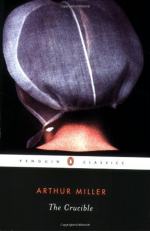
As [August] Strindberg was the most positive influence on O'Neill so [Henrik] Ibsen is the most positive on Arthur Miller. O'Neill as a consequence was primarily interested in analyzing the grinding emotions of man and woman that often lie below the calmer surface emotions. Miller as a consequence is primarily interested in man's sociological aspects. Above all, O'Neill as a dramatist was concerned with character, whereas Miller seems in large part to be concerned with theme and with character only incidentally…. [In] The Crucible, his latest play, we find all theme and no character. His people are spokesmen for him, not for themselves. They possess humanity, when they possess it at all, only in the distant sense that a phonograph recording of it does. They speak and act at an obvious turning of his crank. And the result is a play of large thematic force whose warmth, even heat, remains on the other side of the footlights and is not communicated, save in cold, intellectual terms, to its audience. It is impressive, as a lecture may be impressive, but for the major part it is equally remote from the listener's heart and feeling.

As heretofore, Miller shows himself to be a thoroughly honest and thoroughly sincere dramatist who, unlike the great majority of our present American playwrights, has nothing of the box-office today in his composition, and all credit to him on that score. But he also and at the same time here shows himself as one whose conscious indifference to the box-office seems to be accompanied by an unconscious indifference to any kind of theatrical audience, even one of the higher grade. It may be, of course, that he thought he had worked out his theme in terms of character and so would insinuate it into such an audience's emotion. That I can not tell. But if he did, he has failed. And if, on the other hand, he believed that the sheer vitality of his theme would satisfactorily infiltrate itself in his audience independent of any recognizable and pulsing character to assist it, he has not yet sufficiently educated himself in dramatic eccentricity.

This is a free excerpt of 354 words. There are 899 words (approx. 3 pages at 300 words per page) in the full critical essay.

Read the rest of this Criticism with our Miller, Arthur 1915–: Critical Essay by George Jean Nathan Access Pass.

Copyrights
Miller, Arthur 1915–: Critical Essay by George Jean Nathan from Literature Criticism Series. ©2005-2006 Thomson Gale, a part of the Thomson Corporation. All rights reserved.

Join BookRagslearn moreJoin BookRags


About BookRags | Customer Service | Report an Error | Terms of Use | Privacy Policy

