
BookRags.com Literature Guides Literature Guides Criticism/Essays Criticism/Essays Biographies Biographies My Bibliography Periodic Table U.S. Presidents Shakespeare Sonnet Shake-Up
Research Anything:        
History | Encyclopedias | Films | News | Create a Bibliography | More... Login | Register | Help

Search "Le Guin, Ursula K(roeber) 1929–: Critical Essay by Robert Scholes"

Criticism Navigation


Le Guin, Ursula K(roeber) 1929–: Critical Essay by Robert Scholes

Print-Friendly  Order the PDF version  Order the RTF version
Ursula K. Le Guin
About 4 pages (1,207 words)
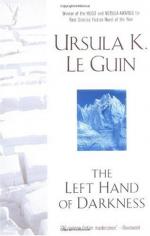
The Left Hand of Darkness Summary

Bookmark and Share

[Ursula K. Le Guin] has been compared to C. S. Lewis, with some appropriateness, especially as concerns her juvenile trilogy, but that comparison fails ultimately because she is a better writer than Lewis: her fictions, both juvenile and adult, are richer, deeper, and more beautiful than his. She is probably the best writer of speculative fabulation working in this country today, and she deserves a place among our major contemporary writers of fiction. For some writers, the SF ghetto serves a useful protective function, preserving them from comparison with their best contemporaries. For Ursula Le Guin, as for others, this protection, and the sense of a responsive, relatively uncritical audience that goes with it, may have been helpful during her early development as a writer. But with The Left Hand of Darkness (1969) she displayed powers so remarkable that only full and serious critical scrutiny can begin to reveal her value as a writer. (p. 2)

The Earthsea trilogy consists of A Wizard of Earthsea (1968), The Tombs of Atuan (1971), and The Farthest Shore (1972)—the order of book publication not quite coinciding with the narrative chronology of the texts. These books have been compared to C. S. Lewis's chronicles of Narnia, especially by English reviewers, for whom this constitutes considerable praise. But the comparison is misleading. Lewis's books are allegories in the narrow sense of that much abused word—his Lion is Christ, and the whole structure of the chronicles is a reenactment of Christian legend…. Ursula Le Guin, in the Earthsea trilogy, relies on the mythic patterns of sin and redemption, quest and discovery, too, but she places them in the service of a metaphysic which is entirely responsible to modern conditions of being because its perspective is broader than the Christian perspective—because finally it takes the world more seriously than the Judeo-Christian tradition has ever allowed it to be taken.

This is a free excerpt of 311 words. There are 1,207 words (approx. 4 pages at 300 words per page) in the full critical essay.

Read the rest of this Criticism with our Le Guin, Ursula K(roeber) 1929–: Critical Essay by Robert Scholes Access Pass.

Copyrights
Le Guin, Ursula K(roeber) 1929–: Critical Essay by Robert Scholes from Literature Criticism Series. ©2005-2006 Thomson Gale, a part of the Thomson Corporation. All rights reserved.

Join BookRagslearn moreJoin BookRags


About BookRags | Customer Service | Report an Error | Terms of Use | Privacy Policy

