
BookRags.com Literature Guides Literature
Guides
Criticism & Essays Criticism &
Essays
Questions & Answers Questions &
Answers
Lesson Plans Lesson
Plans
My Bibliography Periodic Table U.S. Presidents Shakespeare Sonnet Shake-Up
Research Anything:        
History | Encyclopedias | Films | News | Create a Bibliography | More... Login | Register | Help


Kennedy, William 1928–: Critical Essay by Christopher Lehmann-haupt

Print-Friendly  Order the PDF version  Order the RTF version
William Kennedy
About 2 pages (519 words)
Ironweed Summary

Bookmark and Share Know this topic well? Help others and get FREE products!

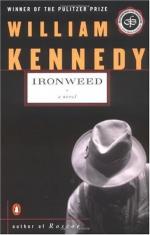
"Ironweed"—which refers to a tough-stemmed member of the sunflower family—recounts a few days in the life of an Albany skid-row bum, a former major-league third baseman with a talent for running, particularly running away, although his ambition now, at the height of the Depression, has been scaled down to the task of getting through the next 20 minutes or so.

The novel is rich in plot and dramatic tension, building as it eventually does, to a violent showdown between a gang of marauding American Legionnaires and a handful of derelicts in a hobo jungle. It is almost Joycean in the variety of rhetoric it uses to evoke the texture and sociology of Albany in the 1930's, particularly the city's Irish community, which by the time of the novel is in full control of the city's politics. And the book is remarkable in its refusal either to sentimentalize or trivialize "life on the bum."

This is a free excerpt of 152 words. There are 519 words (approx. 2 pages at 300 words per page) in the full critical essay.

Read the rest of this Criticism with our Kennedy, William 1928–: Critical Essay by Christopher Lehmann-haupt Access Pass.

Ask any question on Ironweed and get it answered FAST!
Answer questions in BookRags Q&A and earn points toward
discounted or even FREE Study Guides and other BookRags products!
Learn more about BookRags Q&A
Copyrights
Kennedy, William 1928–: Critical Essay by Christopher Lehmann-haupt from Literature Criticism Series. ©2005-2006 Thomson Gale, a part of the Thomson Corporation. All rights reserved.


Join BookRagslearn moreJoin BookRags


About BookRags | Customer Service | Report an Error | Terms of Use | Privacy Policy

