
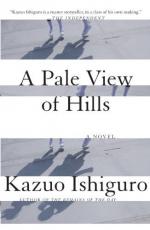
Kazuo Ishiguro has written a first novel of uncommon delicacy. A Pale View of Hills is an extremely quiet study of extreme emotional turbulence, which summons up the various nightmares of a survivor of Nagasaki in a manner that will probably perplex those readers who like to swallow their horrors whole or enjoy being told the worst, at length. It is not Ishiguro's intention to "do" Nagasaki, as other novelists have recently "done" Buchenwald and Babi Yar. Far from it; his commitment in this book is to a private desolation, and he honours that commitment to the letter….
The greater part of A Pale View of Hills takes place during that immediately post-war summer in Nagasaki. Etsuko remembers a woman called Sachiko, who lives with her daughter, Mariko, in a wooden cottage that "had survived both the devastation of the war and the government bulldozers". Sachiko is to all intents and purposes a vagrant, ekeing out an existence on the money she scrounges off gullible people like her new friend, Etsuko. She has immense pride, and cannot disguise the fact that she was born considerably higher up the social scale than her present life would indicate. Etsuko is intrigued by this aloof and elegant outcast and her strangely alienated offspring, and allows herself to be used by Sachiko for their benefit. Sachiko, with her talk of the American lover, Frank, who is soon going to return to the United States with a Japanese wife and stepdaughter, is a vivid presence. Her relationship with the dull, solicitous young housewife who helps her when she is at her most distressed is beautifully suggested in a series of decorous conversations that become increasingly revealing as the story develops. It is what happens to poor little Mariko, however, that is at the heart of the novel and gives it its resonance, and this too is suggested with great attention to the effect it had, and has, on Etsuko's life. Ishiguro very cleverly shows a person exploring the unhappiness of her own past by concentrating on other people….
This is a free excerpt of 342 words. There are 539 words (approx.
2 pages at 300 words per page) in the full critical essay.
Read the rest of this Criticism with our Ishiguro, Kazuo 1954?–: Critical Essay by Paul Bailey Access Pass.

