
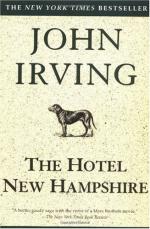
Only an oaf or a meanie could not be touched by a novel as eager and bumptious and cuddly as John Irving's The Hotel New Hampshire…. It's sheer energy all the way, plus magnetic characters, scenic wonders, horrendous happenings, and raffish, boffo jokes on every next page. It warms the mind, tickles the funnybone, squeezes the heart; it alerts concern, then punctures it with a fart, followed by a hug. This book loves us. And if sometimes you can't tell what's cruel from what's hilarious, or the wisdom from the wind, or a paradox from a poignancy—well, that's life or art, vaudeville or psychodrama, nature or nostalgia, and what do you want for a $15.50 top?…
The book's appeal is both obvious and timely; indeed, except for the barnyard stuff and a cosmic purpose that seems more rutting than divine, Reaganites should feel philosophically right at home. Basically, the appeal is to a persevering me-first innocence, a gutsy bootstrap bravado for the lucky in a rough-and-tumble Darwinian Eden—lots of cuteness but in things that matter no quarter given, every opportunity grabbed, no "happy endings" guaranteed, cynicism and "sophomoric despair" specifically eschewed, the accident of "grace" calling forth an upscale irony and poignancy toward the less fortunate, but nothing more. Anything more, it becomes clear, would be, first, untruthful, and second, subversive. Untruthful because the accommodations of life are mainly, and however regrettably, for the advantaged …, and subversive because the sentiment of mercy, of social responsibility beyond family and intimates … is distracting. Our business is the adventure of exploring and getting in tune with fate, and quickly; the stakes are the gemutlich life and survival. (p. 35)
Eliot Fremont-Smith, "Floating Irving" (reprinted by permission of The Village Voice and the author; copyright © News Group Publications, Inc., 1981), in The Village Voice, Vol. XXVI, No. 35, August 26-September 1, 1981, pp. 35-6.
This is a free excerpt of 312 words. There are 316 words (approx.
1 page at 300 words per page) in the full critical essay.
Read the rest of this Criticism with our Irving, John (Winslow) 1942–: Critical Essay by Eliot Fremont-smith Access Pass.

