
BookRags.com Literature Guides Literature
Guides
Criticism & Essays Criticism &
Essays
Questions & Answers Questions &
Answers
Lesson Plans Lesson
Plans
My Bibliography Periodic Table U.S. Presidents Shakespeare Sonnet Shake-Up
Research Anything:        
History | Encyclopedias | Films | News | Create a Bibliography | More... Login | Register | Help


Irving, John 1942–: Critical Essay by Charles Nicol

Print-Friendly  Order the PDF version  Order the RTF version
About 1 pages (358 words)
The 158-Pound Marriage Summary

Bookmark and Share Know this topic well? Help others and get FREE products!

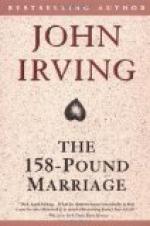
The title [The 158-Pound Marriage] comes from one of the characters who evaluates everything in terms of college wrestling weight classes; it indicates moderate approval. Although the novel is also middleweight in both size and subject, it is all muscle, all confidence and speed and sure grip. (p. 1187)

John Irving knows what he is doing, and his confidence is reflected in his decision to start his novel with two epigraphs, one from Ford Madox Ford's The Good Soldier, the other from John Hawkes's The Blood Oranges—two excellent novels with this same subject. Irving does not suffer in the comparison. He resembles Hawkes, however, in more than mere subject. His narrator, for instance, keeps the same distance between the reader and the story as a Hawkes narrator, neither directly taking charge of his story nor idly reminiscing but telling his experiences in bits and pieces, framing each event in impersonal analysis and personal asides, eventually coming up to the open present and its possibilities. Never totally able to assess the significance of what has happened but admiring its drama and offering interpretations, slightly lost but trying to be helpful, he still seems to hold something back—not because he is trying to conceal any secrets or mislead the reader, but because he is still within the story he tells at the present and hasn't yet completely formed his own opinion about its importance. Another resemblance is the way the characters keep returning to the college gymnasium with its womblike tunnel…. Like the obsessive, pregnant landscapes in a Hawkes novel, this gymnasium is an oversignificant inner mental construct held together more by psychic force than by the rules of architecture, an estranged dream in an alien world of consciousness, a lonely building placed under a spell. Overall, Irving is not quite as sensual, surreal, or mannered as Hawkes, but he has inclinations in all these directions. Both authors view comedy the same way, as a formal dance around the edge of a deep well. (p. 1188)

Charles Nicol, in National Review (© National Review, Inc., 1975; 150 East 35th St., New York, N.Y. 10016), October 24, 1975.

This is a free excerpt of 354 words. There are 358 words (approx. 1 page at 300 words per page) in the full critical essay.

Read the rest of this Criticism with our Irving, John 1942–: Critical Essay by Charles Nicol Access Pass.

Ask any question on The 158-Pound Marriage and get it answered FAST!
Answer questions in BookRags Q&A and earn points toward
discounted or even FREE Study Guides and other BookRags products!
Learn more about BookRags Q&A
Copyrights
Irving, John 1942–: Critical Essay by Charles Nicol from Literature Criticism Series. ©2005-2006 Thomson Gale, a part of the Thomson Corporation. All rights reserved.

Join BookRagslearn moreJoin BookRags


About BookRags | Customer Service | Report an Error | Terms of Use | Privacy Policy

