
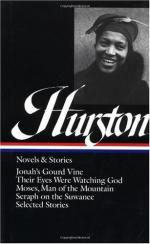
Despite structural and formal defects, Jonah's Gourd Vine is most important for its depiction of the character of the black woman. Lucy is far from being completely developed as a character. She does, however, contain elements seldom seen in fiction by men which feature black women. Moreover, Miss Hurston, in her portrayal of Lucy, has begun early to deal with the conflict between black men and women, which receives fuller explication in Chester Himes's Lonely Crusade and John Williams' Sissie later in the century. The conflict centers around two victims of the same oppressive society. Take John and Lucy as metaphors of black men and women. John, unlike his stepfather, the former slave, is set free in a world which denies him the normal route for the pursuit of manhood. According to Miss Hurston, therefore, he must prove his manhood by having sexual relationships with women other than his wife. He has discovered, in other words, that the black man's route to manhood lay in the exploitation of black women. For no other men in the Euro-American society is this true.
It is not too far wrong to suggest that despite Miss Hurston's fondness for John, in him she has substantiated the theses concerning the black man's overt sexuality; if not more sexually potent than other men, he is assuredly more promiscuous. Thus, John, the metaphor of black men, remains, for Miss Hurston, essentially a creature of appetite, insatiable even though offered such a delectable morsel as Lucy Pearson. Her loyalty, perseverance, and love border upon the messianic. What her husband lacks in courage, strength, and initiative, she more than compensates for. The conflicts, therefore, given such personalities can be resolved only when black men correct the defects in character. That this was the author's implicit commentary upon black men might be attributable to her distorted conception of them. The chances are, however, that she was less interested in John Pearson than in Lucy, less interested in the men of her novels than in the women, who receive more multidimensional treatment.
This is a free excerpt of 340 words. There are 1,140 words (approx.
4 pages at 300 words per page) in the full critical essay.
Read the rest of this Criticism with our Hurston, Zora Neale 1901?–1960: Critical Essay by Addison Gayle, Jr. Access Pass.

