
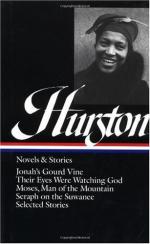
["Moses: Man of the Mountain"] is the story of Moses as the Negro sees and interprets [him]…. None the less reverent in conception than that of the white man, there is one aspect of the work of the great leader of the Israelites which holds particular fascination for the Negro, so that his view becomes especially interesting, and, again always in a reverent way, entertaining. All primitive peoples have an inordinate love of magic, or what appears to be magic, and the African most of all. His descendants in this country may hold that the magic of the radio is more awesome than such relics of voodoo prestidigitation as they may have witnessed or heard about. But even they have traditions that will not die, and one of them, according to Zora Neale Hurston, is that Moses was just about the greatest magician ever in the world. He led his followers out of bondage, because his was better "medicine" than that of Pharaoh's magicians. He talked to God face to face, but he had been singled out by God for this honor because Jehovah recognized the superlative magical power of Moses. Consequently there comes about almost a transposition of Moses and God in the Negro's point of view of their relationship, or so it would seem from Miss Hurston's pages. Moses seems almost to be greater than God. But this is not irreverence, for it is undoubtedly due to the fact that it was easier for a primitive mind to endow a human being with mystical powers than to grasp a purely rational concept of deity. The author's Man of the Mountain is a very living and very human person….
For some reason not apparent the author reduces the dialect as she proceeds, and although a more closely knit narrative is the result, the book loses something in flavor. Moses, rescued by Pharaoh's daughter, is brought up as an Egyptian prince, as the leader of an army; not for a long time is he to be the Mountain Man. According to the Book of Exodus Moses was threescore years of age when he delivered the Children of Israel out of their bondage, but little is told of Moses during the intervening years. It is the legendary Moses whom the Negroes have built that Miss Hurston gives us in the first part of the book, a Moses painted in rich imagination….
This is a free excerpt of 399 words. There are 507 words (approx.
2 pages at 300 words per page) in the full critical essay.
Read the rest of this Criticism with our Hurston, Zora Neale 1901?–1960: Critical Essay by Percy Hutchison Access Pass.

