
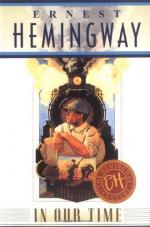
In the attempt to get at the "truth" of real-life experience and to attain the ideal of writing a "classic" that he initially posed for himself, Hemingway began in his early volumes of short stories to describe the adventures of a boy on the threshold of manhood. As Philip Young and Carlos Baker have pointed out in their studies, half of the stories of In Our Time (1925), the first short story collection, are devoted to the development of Nick Adams. They are arranged chronologically, moving from Nick's boyhood to his young manhood, and all of these stories are thematically related. Several more stories about the same character appear in the next two collections, Men Without Women (1927) and Winner Take Nothing (1933). Of importance to the whole of Hemingway's fiction is this early focus on a young hero, for if Philip Young is correct, this hero is to become the prototype "Hemingway Hero" who later will have essentially the same background that Nick has had through his childhood, adolescence, and young manhood. More important than a mere similarity of background in the successive protagonists is the resemblance they bear to each other psychologically. All experience the same needs in meeting the struggle and frustration of twentieth-century man, and even of all men of all times. Some become involved in war, suffer wounds, and are forced to reconcile the psychological disturbances created by these hurts. Others are forced to come to terms with the reality of the traumata created by the pressures of a hostile environment. (pp. 13-14)
In his fiction Hemingway examines the effect upon the inner being of the traumata that modern man has experienced in the world. This attempt to get beyond surface manifestations and deal with more basic, primal contexts led Hemingway to apply certain distinct, psychologically symbolic techniques in his fiction. When these work for him, the entire tone and texture of his prose comes to a close approximation of the "classic" he always tried to write.
This is a free excerpt of 331 words. There are 4,612 words (approx.
15 pages at 300 words per page) in the full critical essay.
Read the rest of this Criticism with our Hemingway, Ernest (Miller) 1899–1961: Critical Essay by Joseph Defalco Access Pass.

