
BookRags.com Literature Guides Literature
Guides
Criticism & Essays Criticism &
Essays
Questions & Answers Questions &
Answers
Lesson Plans Lesson
Plans
My Bibliography Periodic Table U.S. Presidents Shakespeare Sonnet Shake-Up
Research Anything:        
History | Encyclopedias | Films | News | Create a Bibliography | More... Login | Register | Help


Hawkes, John 1925–: Critical Essay by Marc Ratner

Print-Friendly  Order the PDF version  Order the RTF version
Gabriela Mistral
About 6 pages (1,644 words)
John Hawkes Summary

Bookmark and Share Know this topic well? Help others and get FREE products!

Since the appearance of his first novel, The Cannibal, in 1949, the work of John Hawkes has proven him to be a writer whose technical control, poetic imagery and content demand critical recognition. His novels challenge the reader's imagination and force him to read them with the care necessary in reading most modern poetry. The variety of experimental techniques in dealing with time and space in his fiction, the use of fantasy and dream and the pervasive, naturalistic theme of the determinacy of history and myth over men's lives suggest the influence in his work of naturalism and symbolism. In this he belongs to a tradition which combines the Gothic fiction of Charles Brockden Brown and Poe with the compressed symbolism and ironic view of Crane, Bierce and, on occasion, Hemingway. In Hawkes's particular view of the novel and the function of the novelist, the imagination dominates the fact…. Because of his "detached" approach, Hawkes achieves sympathy without sentimentality. His credo might be shared by Djuna Barnes, Nathanael West, Bernard Malamud, James Purdy, and Flannery O'Connor among contemporary writers…. Where Hawkes excels over the tried-and-true "realistic" writers is in the uses of imagination and the power to excite that faculty in the reader. (pp. 345-46)

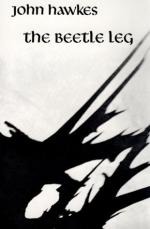
[His technique of reworking myths to convey his perspective of modern man] is most evident in The Beetle Leg (1951), a novel set in the American desert near the site of a dam. The dry season and the figure of the fisherman at the dam are not unfamiliar images from T. S. Eliot's Waste Land. Beyond these, Hawkes's concept of the buried Christ-Osiris in the slowly sliding wall of the dam ("the sarcophagus of mud") is a prime example of his mythopoesis. The imperceptible movement of the retaining wall becomes the inevitable force and movement of the universe and the small absurd heroes, whether their activity is directed towards the wall or the fields, below, cannot check the cosmic flux. (pp. 346-47)

This is a free excerpt of 326 words. There are 1,644 words (approx. 5 pages at 300 words per page) in the full critical essay.

Read the rest of this Criticism with our Hawkes, John 1925–: Critical Essay by Marc Ratner Access Pass.

Ask any question on John Hawkes and get it answered FAST!
Answer questions in BookRags Q&A and earn points toward
discounted or even FREE Study Guides and other BookRags products!
Learn more about BookRags Q&A
Copyrights
Hawkes, John 1925–: Critical Essay by Marc Ratner from Literature Criticism Series. ©2005-2006 Thomson Gale, a part of the Thomson Corporation. All rights reserved.


Join BookRagslearn moreJoin BookRags


About BookRags | Customer Service | Report an Error | Terms of Use | Privacy Policy

