
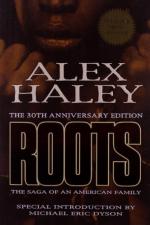
This saga of one man's twelve-year search for his ancestral origin [Roots] owes its success chiefly to white American guilt and Afro-American consciousness…. The Newsweek critique that Roots 'will reach millions of people and alter the way we see ourselves' is one certainly not to be applied to black Africans, who will question the sanity of any man who feels that his ancestral origins are of such significance as to warrant a twelve-year and half-a-million mile search. The inevitable reaction of any such African (I am one) to the resulting book would be … so what?…
This book is sad in a way—from the view that it meant so much to Mr. Haley to embark on this search to find an identity for himself. For this reason only am I happy that he was rewarded with the acclaim and commercial success that the book fetched him. Apart from that, his book is a great disappointment. Through six generations of slaves and freedmen, farmers and blacksmiths, architects and lawyers, lumber mill workers and Pullman porters—and one author, this is a tiresomely long and tediously detailed saga of one Kunta Kinte…. As a dramatic novel describing the anguish and sheer hell of slavery, Roots must rank as the worst slave-novel I have read (my bookshelves boast scores of them). It is written in a patronising manner that makes the reader feel like a nursery-school child being told a fairy-tale by a sweet-smiling female teacher. During the sixteen years of Kunta Kinte's rosy upbringing in the Gambia (made exaggeratedly rosy to emphasise the enormity of his kidnapping into slavery, no doubt), we see happy Kunta indulge in all the rigorous activities to shape him into manhood, except sexual communication. This essential aspect of nature seems to be totally absent from this lad's life, and the only hint that he is ever aware that such a natural phenomenon exists at all is when he has his first baby as a slave.
This is a free excerpt of 326 words. There are 581 words (approx.
2 pages at 300 words per page) in the full critical essay.
Read the rest of this Criticism with our Haley, Alex 1921–: Critical Essay by Dillibe Onyeama Access Pass.

