
 Print
Print Word
Word PDF
PDF|
This section contains 1,044 words (approx. 4 pages at 300 words per page) |

|
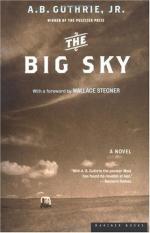
Like Mr. Guthrie's two previous volumes, "The Big Sky," a magnificently pictorial account of the mountain-man era, and the steadily moving "The Way West," which told of the Oregon Trail, "These Thousand Hills" is spaciously conceived and closely thought out. With it, Mr. Guthrie puts beyond question what many of his readers had already guessed, that he is working deliberately and with foresight within the larger intention of depicting the opening and development of the American Northwest.
If this were the only certainty concerning Mr. Guthrie's work as a whole to emerge from "These Thousand Hills," it might give rise to as much uneasiness as hope about what is yet to come in the chronicle. There are ways in which this work is not so strong a book as either of its predecessors, and only too often the task of sustaining a long, planned series, especially within the...
|
This section contains 1,044 words (approx. 4 pages at 300 words per page) |
|



