
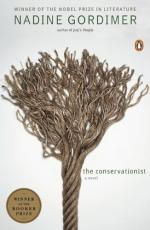
Gordimer has been developing into a major novelist, and The Conservationist is one of the best novels of recent years. While it lacks the flashiness and topicality that have made some commonwealth novels fashionable, its perfection and depth are bound to bring it recognition as one of the most accomplished works of our time. Thickly textured poetic prose, in which narration, memories, fantasy, and dialogue perform an elaborate dance, evokes a sense of character and place comparable to that found in nineteenth-century fiction. Gordimer's previous novels have often had at their center a sensitive liberal who is overwhelmed by the crude violence of modern Africa. In the South African police state, or in the chaos of modern independent Africa, good intentions are often naive, leading to despair. By focusing her narrative on the mind of a progressive successful businessman, Gordimer has avoided the literary traps common to the liberal novel since E. M. Forster. Ideas do not form part of the novel's texture, although they are implied through the son and mistress whom Mehring rejects. Perhaps the only fault of The Conservationist is that the ideas and character of Mehring's left-wing mistress are given a crudeness that seems inappropriate to his own sensibility. We could read the book in various ways—for instance as an illustration of Fanon's theories of the colonial mind on the eve of national liberation. But any such reading is an imposition on the rich, finely grained life portrayed.
In the introduction to her Selected Stories—an intelligent discussion of the artist's sense of reality and fiction—Gordimer speaks of the interplay between the writer's engagement and the society that is portrayed. She illustrates this through her use of the words native, African, then black, which reflect the changing social, moral, and political realities of modern Africa. Her claim is that a writer's subject is "the consciousness of his own era. How he deals with this is, to me, the fundament of commitment." This is different from the usual demand for political engagement, and it shows Gordimer's awareness that over the years she has been creating for her readers a sense of how Africa has changed. The selections from her five volumes of stories included in the present collection illustrate both her growth as an artist and a society in rapid transition…. Gordimer's fine intelligence, shaped by the Cape liberal tradition, attempts to express the sensitivities and fears of her characters, whether they are those with whom she has affinities or those whom we expect to be her enemies.
This is a free excerpt of 419 words. There are 619 words (approx.
2 pages at 300 words per page) in the full critical essay.
Read the rest of this Criticism with our Gordimer, Nadine 1923–: Critical Essay by Bruce King Access Pass.

