
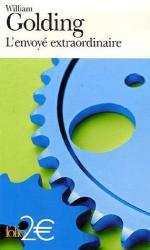
William Golding is evidently a bit fed up with being the author of Lord of the Flies. It was greeted with proper applause when it came out in 1954, but soon became the livre de chevet of American youth, and, worse, a favoured text in the classroom in the years of the great boom in Eng Lit, when a sterile popular variety of the New Criticism was encouraging all manner of dreary foolishness; whereupon the cognoscenti turned away, and called the book naive. Yet it was indeed a noble and a novel performance, to be followed in quick succession by two even more remarkable books, The Inheritors (1955) and Pincher Martin (1956)…. The powerful, idiosyncratic voice came through again—always on new and unpredictable subjects—in Free Fall (1959) and The Spire (1964). But there was less excitement than before and also the rate of production slackened. In 1972 there were, among the three novelle of The Scorpion God, two of Golding's best things, exhibiting his extraordinary blend of intensity and remoteness, that central inexplicitness within the explicit for which he is always trying. And Darkness Visible, three years ago, seemed to indicate a continuance of the old powers, perhaps augmented (as sometimes happens) by an audacity that comes as a grace to some artists in old age. Like Matty, hero of Darkness Visible, in his happy time, Golding holds that there is nothing hid which shall not be manifested, and nothing kept secret but that it should come abroad. He will utter things which have been kept secret from the foundation of the world, as many of them as he can: for this is what he takes novels, like parables, to be for. The effort involved is extraordinary; he has grown more willing to discuss it, but no more able to say exactly what it entails.
This new book [A Moving Target] is his second collection of occasional pieces, and in the Preface he remarks that when asked to speak about his own work he has always tried to resist, but 'has always given way in the end so that at last I find myself talking about myself with the grossest liberality'. But his own work is not the only subject of this book, and some of the other pieces—though not, by any means, all of them—give one no less useful insights into his unique yet traditional talent…. [One] always senses behind the novelty of Golding's achievements something that is not quite of his moment.
This is a free excerpt of 413 words. There are 1,275 words (approx.
4 pages at 300 words per page) in the full critical essay.
Read the rest of this Criticism with our Golding, William (Gerald) 1911–: Critical Essay by Frank Kermode Access Pass.

